Where every prayer is answered.
I want it now, I want it all. At one level it might be thought that this is just the cry of a child at a candy store. Perhaps it is the cultural contradiction of capitalism. The fundamental tension between a sacrifice for future rewards and 'instant living' is undermined by the overwhelming desire to consume everything now and apres moi, le deluge. In another respect, the great thinker Hans Jonas would ask how such a nihilistic tendency could allow for a care for the earth and a responsibility to future generations since the very notion of responsibility loses its binding force.
Eternal sunshine. But like the Joker's face, a permanent smile becomes quite grotesque.
Leafing through Joel Sternfeld's latest book and came across the curious fact that a large proportion of the Utopian experiments to set up small-scale communes or experimental communities were to be found in California. And the question is asked: How did it all go wrong? Why is it that such idealism invariably ended up in ruin, disaster and heartache? The Rappites, the Exodusters... Is it because nothing of the collective spirit can survive on a soil where the 'I ' is king, where the social is replaced by the spectacle and a series of images, and where libertarianism is really a theory of missing persons? [Of course, large-scale, scientific socialism, wasn't any more successful].
The ceremony of innocence is drowned.
Ceremony?
From Joan Didion's Slouching to Bethlehem:
My mother was a genuine all-American bitch.
The centre was not holding. It was a country of bankruptcy and commonplace reports on casual killings and misplaced children and abandoned homes and vandals who misspelled even the four-letter words they sprawled. It was a country in which families routinely disappeared...sloughing off both the past and the future as snakes shed their skin. Children, who were never taught and who would now never learn the games that held society together..It was not a country in open revolution... It was the United States of America in the late cold spring of 1967.
An excerpt which seemed to capture the tone of the essay:
This chick tells me there's no meaning to life but it doesn't matter, we'll just flow right out. [On] the East Coast at least I had a 'target'. At least there you expect it's going to 'happen'...Here you know its not going to.
I ask what it is that is supposed to happen.
I don't know, he says. Something. Anything.
Between 1945 and 1967 maybe we had stopped believing in the rules ourselves, maybe we were having a failure of nerve about the game..they are less in rebellion against the society than ignorant of it.
Notes from Roth:
Life at the surface. The perfect life, the false smile, the grin that one at first thinks covers layers of complexity before one realises that the mask is all there is. The horror, the horror. Beyond the visual shallowness, flatness, emptiness, there is no reality and this calls for a certain theatricality. Is this the ultimate meaning of Hopper's paintings?
Picket fences. Arcadia, the idyll. American Pastoral, the long summer evenings without a past or future. It was the summer of '69 and it lasted forever. But, as in David Lynch's films, behind the calm seamless life of suburbia lies a terrifying quiet desperation. To be exactly as one seems. The holy grail of authenticity. I am what I am. A strange desire to imagine oneself as innocent, to envisage any change as meaning the world will never be the same again. The fall from grace is always on a grand scale (Nixon, Clinton); the scandals, the deviancy are relished all that bit more because they deliver the opportunity to pontificate on the evils of the world. Surely this is a legacy of the first settlers, surrounded by heathens, witches, 'Negroids', Jews, proto-commies, the licentious rabble...
The conservative reaction against the 'permissive society' is not that new nor, I think, is the drama of a life spinning hopelessly out of control. Is Utopianism anything but a desire to return to that simple, first moment, that closed world, pure and uncomplicated by the existence of 'others' and desire (to be in Paradise alone), free from the order of society, the Church, authority, government?
The intensity of shallowness.
Not to be seduced by the charm of the tyrant or a profound conservatism, the spirit's longing for order finds its home somewhere else. The childishness of Romantic idealism is rejected and instead one gives oneself over to the pragmatic spirit, the dullness and averageness of the bourgeoisie's ideal; The American dream was to be the ordinary, regular guy, the girl next door that made it. A member of the moral majority whose core values were sound, respectable. And all along, no-one realised that the consumerist ethic that had at one time required such stability and conformity (that appropriate to an undifferentiated 'mass society) was now being unravelled, now pointing in other directions.
Tuesday, January 30, 2007

Monday, January 29, 2007
The Buddha of Suburbia
Be compassionate..always seek active kindness...Friends, the world is imaginary, only I am the real thing. The world of desire is full of tribulations, but learn to say after me, I'm lovin' it...
Robert Hughes was, perhaps, right after all to say with regard to Hopper that the frontier had moved inwards. Having pushed as far westward as possible the only logical place to go was inward. G.S.Wood makes the intriguing point that the frontier was fundamental to the establishment of politics: the constant expansion of it would prevent any one interest group from dominating and corruption-the plague of old Europe-would be avoided (of course, in practical terms the grim reality of inclusion was quite something else: The American blacks were 3/5 ths of a human being under the Constitution and the Red Man, well, he was not even considered human at all!).
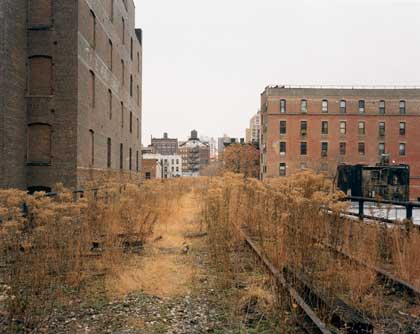
[Joel Sternfeld..California]
This retreat inwards, the decline of the public world, is itself a result of capitalism and this was already well understood by those who saw modern commercial society engendering a passive citizenship to the detriment of the republican ideal. The move to a virtual, abstract reality, is directly mirrored by the the development of the disembedding and de-territorializing processes of globalisation.
It is not surprising, then, that there should be so much suspicion of the 'outside' world, full as it is of injustice and impersonal forces, deceptions and conspiracies or 'codes' to be unlocked. Only the self is real..a divine spark lost in an opaque universe. We live in a gnostic age, a therapeutic state, and our new god is warmth. Is this why there is so much psychobabble floating about and will modern communications like the Internet exacerbate this? Is it any wonder, then, that everyone wants to be a Buddha in suburbia?
Universal Arrogance
The Iranians may be deluded-certainly the regime's pronouncements on the Holocaust are a clear indication of collective madness-but in one thing they are surely right: America, the 'city on the hill', represents not the universal nation, but universal arrogance. It is the arrogance of the missionary who believes that he and only he is virtuous, whilst the rest of the world is damned
"The Puritans first conjured up the notion of America as a redeemer nation with a sacred mission, popularised the jeremiad - a sermon of complaint against backsliding and declension - which would become in time 'a kind of American anthem', and set precedents for the harsh treatment of demonic otherness. The Puritans confronted their own axis of evil - Quakers, Indians, antinomians, witches - and established an American pattern of waging external war as 'an idealistic moral crusade against a satanic foe' and of purging domestic society of heretics and 'scary, hidden subversives' when these threatened the community's divine vocation"
I was struck by a Brookings Institute report today that claims that America's failure in Iraq is down to her ignorance of history. This, to me, is truer than it first appears. For to live in a bubble, a virtual reality, where other people are mere dots or dreams, where war is a spectacle presented by CNN, and even the attack on the Twin Towers elicited the response : "I thought it was film," will invariably lead to such a 'disconnect'. It is , as Gibbon saw so clearly, a recipe for disaster, staggering folly, both at a personal and monumental level....
[society and the Holy..]
We have to destroy the city before we can save it.
These were the famous words from Vietnam but are equally applicable here. Is it any wonder, then, that the favourite song of the Marines has the lines, 'Burn motherf**er, burn'? Not quite the Wagner from the films!
"The Puritans first conjured up the notion of America as a redeemer nation with a sacred mission, popularised the jeremiad - a sermon of complaint against backsliding and declension - which would become in time 'a kind of American anthem', and set precedents for the harsh treatment of demonic otherness. The Puritans confronted their own axis of evil - Quakers, Indians, antinomians, witches - and established an American pattern of waging external war as 'an idealistic moral crusade against a satanic foe' and of purging domestic society of heretics and 'scary, hidden subversives' when these threatened the community's divine vocation"
I was struck by a Brookings Institute report today that claims that America's failure in Iraq is down to her ignorance of history. This, to me, is truer than it first appears. For to live in a bubble, a virtual reality, where other people are mere dots or dreams, where war is a spectacle presented by CNN, and even the attack on the Twin Towers elicited the response : "I thought it was film," will invariably lead to such a 'disconnect'. It is , as Gibbon saw so clearly, a recipe for disaster, staggering folly, both at a personal and monumental level....
[society and the Holy..]
We have to destroy the city before we can save it.
These were the famous words from Vietnam but are equally applicable here. Is it any wonder, then, that the favourite song of the Marines has the lines, 'Burn motherf**er, burn'? Not quite the Wagner from the films!
Saturday, January 27, 2007
From the Archives
The west abandons mythological repetition only to impose on itself a repetition diffused through matter.
---Roberto Calasso.
It's interesting because we think of modern western life as a passage through fleeting and evolving landscapes, but at the same time we can literally barricade ourselves into self-sustaining little worlds that we can watch perpetually go round; favourite books would do this, now we have the entire season of whatever on DVD, entire worlds we can disappear into, all the time.
---Citizen.
I've written on this before (Dec.10th : 'Repetition and Ritual' ) and I don't quite understand this compulsion to repeat. Perhaps living in a riskier world means there is a greater need to find security in the familiar and so we repeat ourselves. Perhaps living in an age which has broken free from circular time and stepped into the irreversible, the radically new, such conservation isn't that surprising. Christopher Booker wrote that the future stopped in the Seventies-since then we've been mad about conservation: retro culture, but also ecology and knowledge. And here we have the great paradox: a system that has no regard for the past, that is founded on the destruction of the past, goes to great lengths to preserve it in museums and libraries.
Whenever I go to the British Library I feel as if I'm returning home. The great black monolithic space at the centre is , I'm sure, a sort of Ka'ba for some. And yet, the books on display there serve to emphasise knowledge as a spectacle, something that is out of hand, encased and preserved from withering time. Is this so different from the Eloi? Fourteen million books and documents and counting...
C on the Internet:
Information. Photographs. Life history. Everything is stored in the archives. God help us if there's a glitch. Everything is remembered by the relentless eye. We will have vast storehouses of knowledge..and no one will be able to read or have the time to do so! There's something obscene, perhaps, in the way in which the images of those who have passed away continue to be present on the Internet. It's not good manners! The dead should be buried and not be made visible like that (of course, the past should live on, but in life and in memory, in an appropriate place, not an open space).
But perhaps we are being hasty here. For does not the light of stars long extinguished still reach us and delight us? And these irises and bluebells..were they not melancholy people we once knew, and this sunflower here, was she not a brilliant soul I once met? So many of the dead live amongst us...
The first thing a stranger notes about London is how homogeneous its building are. Everything and everyone looks the same (this is not just the usual, instinctive stereotyping..it is worth asking the question of how local distinctiveness was worked over first by industrialisation and then by the media into a 'mass society': housing, clothes, tastes). How odd that a society that prides itself on individualism should live under the sign of the Same!
---Roberto Calasso.
It's interesting because we think of modern western life as a passage through fleeting and evolving landscapes, but at the same time we can literally barricade ourselves into self-sustaining little worlds that we can watch perpetually go round; favourite books would do this, now we have the entire season of whatever on DVD, entire worlds we can disappear into, all the time.
---Citizen.
I've written on this before (Dec.10th : 'Repetition and Ritual' ) and I don't quite understand this compulsion to repeat. Perhaps living in a riskier world means there is a greater need to find security in the familiar and so we repeat ourselves. Perhaps living in an age which has broken free from circular time and stepped into the irreversible, the radically new, such conservation isn't that surprising. Christopher Booker wrote that the future stopped in the Seventies-since then we've been mad about conservation: retro culture, but also ecology and knowledge. And here we have the great paradox: a system that has no regard for the past, that is founded on the destruction of the past, goes to great lengths to preserve it in museums and libraries.
Whenever I go to the British Library I feel as if I'm returning home. The great black monolithic space at the centre is , I'm sure, a sort of Ka'ba for some. And yet, the books on display there serve to emphasise knowledge as a spectacle, something that is out of hand, encased and preserved from withering time. Is this so different from the Eloi? Fourteen million books and documents and counting...
C on the Internet:
Information. Photographs. Life history. Everything is stored in the archives. God help us if there's a glitch. Everything is remembered by the relentless eye. We will have vast storehouses of knowledge..and no one will be able to read or have the time to do so! There's something obscene, perhaps, in the way in which the images of those who have passed away continue to be present on the Internet. It's not good manners! The dead should be buried and not be made visible like that (of course, the past should live on, but in life and in memory, in an appropriate place, not an open space).
But perhaps we are being hasty here. For does not the light of stars long extinguished still reach us and delight us? And these irises and bluebells..were they not melancholy people we once knew, and this sunflower here, was she not a brilliant soul I once met? So many of the dead live amongst us...
The first thing a stranger notes about London is how homogeneous its building are. Everything and everyone looks the same (this is not just the usual, instinctive stereotyping..it is worth asking the question of how local distinctiveness was worked over first by industrialisation and then by the media into a 'mass society': housing, clothes, tastes). How odd that a society that prides itself on individualism should live under the sign of the Same!
Friday, January 26, 2007
Distance is the Soul of Beauty
C. Milosz's great lecture is here
"What is this enigmatic impulse that does not allow one to settle down in the achieved, the finished? I think it is a quest for reality. I give to this word its naive and solemn meaning, a meaning having nothing to do with philosophical debates of the last few centuries.... Undoubtedly, that Earth is and her riches cannot be exhausted by any description.
Not soon, as late as the approach of my ninetieth year,
I felt a door opening in me and I entered
the clarity of early morning.
Moments from yesterday and from centuries ago
-a sword blow, the painting of eyelashes before a mirror
of polished metal, a lethal musket shot, a caravel
staving its hull against a reef - they dwell in us,
waiting for a fulfillment.
I knew, always, that I would be a worker in the vineyard,
as are all men and women living at the same time,
whether they are aware of it or not.
----------
On the day the world ends
A bee circles a clover,
A Fisherman mends a glimmering net.
Happy porpoises jump in the sea,
By the rainspout young sparrows are playing
And the snake is gold-skinned as it it should always be.
On the day the world ends
Women walk through fields under their umbrellas
A drunkard grows sleepy at the edge of a lawn,
Vegetable peddlers shout in the street
And a yellow-sailed boat comes nearer the island,
The voice of a violin lasts in the air
And leads into a starry night.
Only a white-haired old man, who would be a prophet,
Yet is not a prophet, for he's much too busy,
Repeats while he binds his tomatoes:
No other end of the world there will be,
No other end of the world there will be.
--------
You walk by smashed stones
with the fragments of a name
Yet this water in the sun, the
scent of calamus,
The same ecstasy of discovering things
Unites us. You will find again
The sacredness they tried to expel forever.
Something returns, invisible, frail, shy.
Adoring, without a name, and yet fearless.
----Selections from C. Milosz
"What is this enigmatic impulse that does not allow one to settle down in the achieved, the finished? I think it is a quest for reality. I give to this word its naive and solemn meaning, a meaning having nothing to do with philosophical debates of the last few centuries.... Undoubtedly, that Earth is and her riches cannot be exhausted by any description.
And yet perhaps our most precious acquisition is not an understanding of those ideas, which we touched in their most tangible shape, but respect and gratitude for certain things which protect people from internal disintegration and from yielding to tyranny. Precisely for that reason some ways of life, some institutions became a target for the fury of evil forces, above all, the bonds between people that exist organically, as if by themselves, sustained by family, religion, neighborhood, common heritage. In other words, all that disorderly, illogical humanity, so often branded as ridiculous because of its parochial attachments and loyalties. In many countries traditional bonds of civitas have been subject to a gradual erosion and their inhabitants become disinherited without realizing it.
Our planet that gets smaller every year, with its fantastic proliferation of mass media, is witnessing a process that escapes definition, characterized by a refusal to remember. .... In the minds of modern illiterates, however, who know how to read and write and even teach in schools and at universities, history is present but blurred, in a state of strange confusion; Molière becomes a contemporary of Napoleon, Voltaire, a contemporary of Lenin. Also, events of the last decades, of such primary importance that knowledge or ignorance of them will be decisive for the future of mankind, move away, grow pale, lose all consistency as if Frederic Nietzsche's prediction of European nihilism found a literal fulfillment. "The eye of a nihilist" - he wrote in 1887 - "is unfaithful to his memories: it allows them to drop, to lose their leaves;... And what he does not do for himself, he also does not do for the whole past of mankind: he lets it drop".
For how to be above and simultaneously to see the Earth in every detail? And yet, in a precarious balance of opposites, a certain equilibrium can be achieved thanks to a distance introduced by the flow of time. "To see" means not only to have before one's eyes. It may mean also to preserve in memory. "To see and to describe" may also mean to reconstruct in imagination. A distance achieved, thanks to the mystery of time, must not change events, landscapes, human figures into a tangle of shadows growing paler and paler. On the contrary, it can show them in full light, so that every event, every date becomes expressive and persists as an eternal reminder of human depravity and human greatness. Those who are alive receive a mandate from those who are silent forever. They can fulfill their duties only by trying to reconstruct precisely things as they were, and by wresting the past from fictions and legends.Thus both - the Earth seen from above in an eternal now and the Earth that endures in a recovered time - may serve as material for poetry. "
Not soon, as late as the approach of my ninetieth year,
I felt a door opening in me and I entered
the clarity of early morning.
Moments from yesterday and from centuries ago
-a sword blow, the painting of eyelashes before a mirror
of polished metal, a lethal musket shot, a caravel
staving its hull against a reef - they dwell in us,
waiting for a fulfillment.
I knew, always, that I would be a worker in the vineyard,
as are all men and women living at the same time,
whether they are aware of it or not.
----------
On the day the world ends
A bee circles a clover,
A Fisherman mends a glimmering net.
Happy porpoises jump in the sea,
By the rainspout young sparrows are playing
And the snake is gold-skinned as it it should always be.
On the day the world ends
Women walk through fields under their umbrellas
A drunkard grows sleepy at the edge of a lawn,
Vegetable peddlers shout in the street
And a yellow-sailed boat comes nearer the island,
The voice of a violin lasts in the air
And leads into a starry night.
Only a white-haired old man, who would be a prophet,
Yet is not a prophet, for he's much too busy,
Repeats while he binds his tomatoes:
No other end of the world there will be,
No other end of the world there will be.
--------
You walk by smashed stones
with the fragments of a name
Yet this water in the sun, the
scent of calamus,
The same ecstasy of discovering things
Unites us. You will find again
The sacredness they tried to expel forever.
Something returns, invisible, frail, shy.
Adoring, without a name, and yet fearless.
----Selections from C. Milosz
Wednesday, January 24, 2007
Only me, only time

When the child was a child,
it didn’t know that it was a child,
everything was soulful,
and all souls were one
When the child was a child,
it awoke once in a strange bed,
and now does so again and again.
Many people, then, seemed beautiful,
and now only a few do, by sheer luck
When the child was a child,
It reached for cherries in topmost branches of trees
with an elation it still has today,
has a shyness in front of strangers,
and has that even now.
It awaited the first snow,
And waits that way even now.
To wake up in the morning and find the earth covered by a blanket of snow is one of the joys of childhood. The earth recovers something of her primitive simplicity, her spontaneity. The snow slows down time...
And still, it must be said, the first snowfall of the season has the capacity to fire the imagination, to rekindle the innocence that some thought was lost. Like an underground stream that suddenly emerges into the open, we are reminded that though some things may be forgotten or hidden from our eyes we can always reclaim the lost treasures. Time can be regained...
A hundred new worlds lie in its verses
Whole centuries are involved in its moments
----The Allama
Who is to say only me? To say 'I' is already to affirm the speech and language of others, is already to place oneself in the world. The stones, the trees, the kingfishers also affirm...
Who is to say there is only time? To recognize time, to take joy in a fleeting moment, to be aware of the deep rhythms of the seasons, is already to point to what lies beyond time, to understand that the miraculous is already folded in the moments of time.
Tuesday, January 23, 2007
Remembrance of Things Past

Strange dream last night. Lots of black crows waiting aimlessly under some dark trees. Large, dark fruit-blackberries-had fallen to the ground but the floor was covered with blood and I knew immediately they were flesh, not fruit, and that this was a scene of death. Of course, this was just a remembrance of the haunting image from "strange fruit". Of course.
Mulling aimlessly around for a book to read at Borders. Zizek, who does my head in, or Agamben. Then, by chance, I come across a book, Radical Hope.
But when the buffalo went away the hearts of my people fell to the ground, and they could not lift them up again. After this nothing happened. There was little singing anywhere. "Besides", he added sorrowfully, " you know that part of my life as well as I do. You saw what happened to us when the buffalo went away."
What is it for history to exhaust itself, for there to be no more meaning or structure against which one's life would make any sense? The Reservations are like Frinton-on-the-sea: huge waiting grounds..waiting for death to overcome you..like a black bird....
Does history itself, happenings, come to an end or is this only a subjective feeling of the Crows: as if to say, this seems like an end for us, what else could there be? We must put questions of psychology to one side. What if the Crow Chief's statement is true, what if this is a question of ontology and what if he is not just nostalgic for a vanished past but a witness to the end of experience, to the death of a way of life? The last spokesman of a disappearing world can only give testimony to the last moments.
A necessary diversion: Cavell on Kierkegaard 'Authority and Revelation':
The concept of authority [and Revelation] has been entirely forgotten in our confused age. We are not even sure what it means to be obedient any more. How can we once again get a clarity about certain dogmatic concepts and an ability to use them.
Luther's problem was to combat a foreign institution motivated politically or economically, but Kierkegaard's problem is that the mind itself has become political and economic...Luther's problem was to combat false definitions of religious categories, but Kierkegaard has to provide definition for them from the very beginning...the problem is that no one remembers what a promise is, nor has the authority to accept one.
The question being addressed here is: have words lost their force, have we lost the very ability to understand certain concepts...whether anything any longer could conceivably count for us as a revelation?
There is a dialectical shift in our understanding of concepts depending on the contexts in which they are embedded. We can talk of a qualitative shift when we move from "immanent" to "transcendent" contexts. [This mirrors Eckhart when he says that we cannot attribute Being to God and man in the same way].
Kierkegaard describes what the life of a man will look like which calls for the description, which can only be understood in terms of-which ( he sometimes puts it) is lived in Christian categories. A man's life; not a striking experience here and there, or a pervasive mood or a particular feeling or set of feelings. As if to say: in that life, and for that life, the Christian categories have their full, mutually implicating meaning, and apart from it they may have any or none.
"This night thy soul shall be required of thee"; know what they mean not just in some sense, but know what they mean in a sense we may wish to call heightened. We may know or understand them even if we cannot explain them..that we use such words on specific occasions is itself an indication that they are understood.
"To imagine a language is to imagine a form of life"---Wittgenstein.
When a form of life can no longer be imagined, its language can no longer be understood...to understand an utterance religiously you have to be able to share its perspective. (In these ways, speaking religiously is like telling a dream). There seems to be no reason not to believe that, as a given person may never occupy this stage [of life] , so a given age , and all future ages, may as a whole not occupy it-that the form will be lost from men's lives altogether.
"Most men live in relation to their own self as if they were constantly out, never at home.."out" in a foreign land..spiritually and religiously understood, perdition consists in journeying into a foreign land, in being "out". " ---Kierkegaard.
One may want to say: A human being can be a complete enigma to himself ....because he does not know why he lives as he does., what the point of his activity is; he understands his words but is foreign to his life.
Some are alienated not just from society but from the lives common to their times; which is perhaps the same as seeing their time as alienated from its past, to say that forms are broken, that time itself has come to a stop...nothing happened.
In such circumstances it is easy to fall back into silence or the absurd. Is there anything left to say and even if there was, who would understand us?
The thing we must look for,in each case, is the man who, contrary to appearance, and in spite of all, speaks....
[hans Jonas: after auschwitz;]
Monday, January 22, 2007
I feel that there is much to be said for the Celtic belief that the souls of those whom we have lost are held captive in some inferior being, in an animal, in a plant, in some inanimate object, and so effectively lost to us until the day (which to many never comes) when we happen to pass by the tree or to obtain possession of the object which forms their prison. Then they start and tremble, they call us by our name, and as soon as we have recognised their voice the spell is broken. We have delivered them: they have overcome death and return to share our life.
After this nothing happened.
Have we lost the very concepts in which events would take shape, form a pattern, mean something? The conceptual world in which the act has an identity, an intelligibility, has broken down. We suspect this is a possibility for all of us-and not just for the Crows. The unforeseeable, the unimaginable, is not death or failure but the reservations, the camps, where nothing happens. The unimaginable has become a possibility. Hannah Arendt was right to highlight the enormity of such an occurrence. The necessary, fixed field of possibilities comes to be questioned. Nothing is stable any more; the very framework itself ceases to make sense and cannot be trusted. What else would one call this but disorientation or bewilderment?
To lose the land is to lose a way of life and a way of thinking.
Fort Laramie Treaty, September 17 th, 1851: The Crows are ceded 33 million acres and promised $50,000 worth of supplies every year (they receive it only on one year!) . By the 1860's and the second Treaty this has been reduced to 25 %: eight million acres, and by 1882 it is down to 2 million.
A way of life has been destroyed. The Crow now lives in a world in which their are no living possibilities. He is like the Musselmaner. A black shadow. The field in which occurrences took place has been torn open and all rituals (such as the Sun Dance-which is outlawed and then forgotten), like all acts, are empty..they are broken circles. Nothing counts any more..we are beyond good or evil since the very concept of 'limit' has lost its meaning. And this is not unexpected: Concepts get their lives through the lives we are able to live with them.
For the Crow, they have quite literally, run out of time. A time when things happened is now consigned to the past. And yet,and yet...In a quite remarkable gesture, Plenty Coups, leader of the Crows, places his coup-stick and head-dress on the memorial to the Unknown Solider at the 1921 Washington ceremony. What can this mean? Is he burying them as well? Perhaps this is a final, defiant act, as if to say: I recognize that the only ritual possible for us now is one of remembering and mourning and by speaking of such things they will be kept alive..that by a loving act of remembrance of things past we shall name what has been taken from us and one day the land will tremble, the spirit of our fathers will haunt the white man, eventually breaking his spell, and they shall return to share our life...
I don't know if these are Plenty Coup's words from the ceremony but I like to think that they are because they are wonderfully subversive...
Translation 1:
"For the Indians of America I call upon the great spirit of the Red Men with gesture, and chant, and tribal tongue: That the dead should not have died in vain; that war might end; that peace be purchased by the blood of red men and white.
Translation 2:
I am told that this soldier is one who is known only to God. If that is the case, this soldier, known only to the "Maker" could
well be an American Indian. With all of the honors being extended to him this day, by all of the countries that were in the war, he truly is a chief. And in keeping with the rites that we extend to a departed chief, I hereby dedicate this grave as the grave site of a chief."
After this nothing happened.
Have we lost the very concepts in which events would take shape, form a pattern, mean something? The conceptual world in which the act has an identity, an intelligibility, has broken down. We suspect this is a possibility for all of us-and not just for the Crows. The unforeseeable, the unimaginable, is not death or failure but the reservations, the camps, where nothing happens. The unimaginable has become a possibility. Hannah Arendt was right to highlight the enormity of such an occurrence. The necessary, fixed field of possibilities comes to be questioned. Nothing is stable any more; the very framework itself ceases to make sense and cannot be trusted. What else would one call this but disorientation or bewilderment?
To lose the land is to lose a way of life and a way of thinking.
Fort Laramie Treaty, September 17 th, 1851: The Crows are ceded 33 million acres and promised $50,000 worth of supplies every year (they receive it only on one year!) . By the 1860's and the second Treaty this has been reduced to 25 %: eight million acres, and by 1882 it is down to 2 million.
A way of life has been destroyed. The Crow now lives in a world in which their are no living possibilities. He is like the Musselmaner. A black shadow. The field in which occurrences took place has been torn open and all rituals (such as the Sun Dance-which is outlawed and then forgotten), like all acts, are empty..they are broken circles. Nothing counts any more..we are beyond good or evil since the very concept of 'limit' has lost its meaning. And this is not unexpected: Concepts get their lives through the lives we are able to live with them.
For the Crow, they have quite literally, run out of time. A time when things happened is now consigned to the past. And yet,and yet...In a quite remarkable gesture, Plenty Coups, leader of the Crows, places his coup-stick and head-dress on the memorial to the Unknown Solider at the 1921 Washington ceremony. What can this mean? Is he burying them as well? Perhaps this is a final, defiant act, as if to say: I recognize that the only ritual possible for us now is one of remembering and mourning and by speaking of such things they will be kept alive..that by a loving act of remembrance of things past we shall name what has been taken from us and one day the land will tremble, the spirit of our fathers will haunt the white man, eventually breaking his spell, and they shall return to share our life...
I don't know if these are Plenty Coup's words from the ceremony but I like to think that they are because they are wonderfully subversive...
Translation 1:
"For the Indians of America I call upon the great spirit of the Red Men with gesture, and chant, and tribal tongue: That the dead should not have died in vain; that war might end; that peace be purchased by the blood of red men and white.
Translation 2:
I am told that this soldier is one who is known only to God. If that is the case, this soldier, known only to the "Maker" could
well be an American Indian. With all of the honors being extended to him this day, by all of the countries that were in the war, he truly is a chief. And in keeping with the rites that we extend to a departed chief, I hereby dedicate this grave as the grave site of a chief."
Sunday, January 21, 2007
Two Hours and a Bit
I have two hours to read on Saturday-thirty five minutes extra if one includes the tube journey. No time to absorb what I'm reading, just see what catches my eye and transcribe it like a clerk.
H.P.L.
At the intersection of these channels of communication, man has erected giant ugly metropolises where each person, isolated in an anonymous apartment, in a building identical to the others , believes absolutely that he is the centre of the world and the measure of all things. But beneath the warrens of these burrowing insects, very ancient and powerful creatures are awakening from their slumber.
(on New York):
Coming for the first time upon the town, I had seen in the sunset from a bridge, majestic above its waters, its incredible peaks and pyramids rising flower-like and delicate from pools of violet mist to play with the flaming-golden clouds and the first stars of evening. Then it had lighted up window by window above the shimmering tides where lanterns nodded and glided and deep horns bayed weird harmonies., and itself became a starry firmament of dream redolent of faery music.
This ecstasy soon gives way to:
...elephantiasis of climbing, spreading stone where the moon had hinted loveliness and elder magic.; and the throngs of people who seethed through flume-like streets were squat , swarthy strangers with hardened faces and narrow eyes.
And soon:
Houllebecq:
'Dressed in their rigid, rather grim clothes, accustomed to repressing their emotions and desires; the Protestant Puritans of New England may at times have succeeded in forgetting their animal origin...But in the presence of "Negroes" he [Lovecraft] experiences an irrepressible reaction of his nervous system. Their vitality, their apparent lack of complexes or inhibitions, terrifies and repulses him. They dance in the street, listen to music , they talk out loud. ..Life seems to amuse them, which is worrying. Because life is itself evil.'
One comes away from that feeling somewhat dirty, tainted. Reminds me of what K.Clark said about New York: it isn't ugly-from a distance. If all that complexity produces is darkness then a simple innocence is to be infinitely preferred. This idea of impurity and danger was to have disastrous consequences for the 20 th century...
One hour left:
Badiou on Holderin:
'And fidelity has not been given to our soul as a vain present
And not for nothing was in
Our souls loyalty fixed.'
The homeland (childhood?) is what always escapes , what one always loves, loves to escape. The homeland would be a desert if it didn't already contain the irruption of place into space or the shadows of departure; already the land foretold of those who would desert her; she contained all possibilities: wanderings and migrations, homecomings and heartaches. The land would not be the land if it did not awaken us to our own strangeness, our alienation from the earth.
'There is a yearning that seeks the unbound. But much
Must be retained. And fidelity is needed.
Forward, however, and back we will
Not look. Be lulled and rocked as
On a swaying skiff of the sea. '
A crooked path, a serpent's dream, a difficult freedom; without God are there but empty circles? Nature is not 'objective' or 'the given'-but a gift , an opening up, the very possibility of opening ..an outstretched hand.
We owe God a death.
Religio =debt, 'Day of Judgement' = Day of repayment.
From an interview with Larkin:
'What about Asherby and I'd say I prefer strawberry., that sort of thing. I suppose everyone has his own dream of America. A writer once said to me, If you ever go to America, go either to the East Coast or the West Coast, the rest is a desert full of bigots.
Mercifully, the tube journey is spent reading the delightfully charming Molly Hughes and all dark thoughts are dispelled once again...as simple as that. So there you are!
H.P.L.
At the intersection of these channels of communication, man has erected giant ugly metropolises where each person, isolated in an anonymous apartment, in a building identical to the others , believes absolutely that he is the centre of the world and the measure of all things. But beneath the warrens of these burrowing insects, very ancient and powerful creatures are awakening from their slumber.
(on New York):
Coming for the first time upon the town, I had seen in the sunset from a bridge, majestic above its waters, its incredible peaks and pyramids rising flower-like and delicate from pools of violet mist to play with the flaming-golden clouds and the first stars of evening. Then it had lighted up window by window above the shimmering tides where lanterns nodded and glided and deep horns bayed weird harmonies., and itself became a starry firmament of dream redolent of faery music.
This ecstasy soon gives way to:
...elephantiasis of climbing, spreading stone where the moon had hinted loveliness and elder magic.; and the throngs of people who seethed through flume-like streets were squat , swarthy strangers with hardened faces and narrow eyes.
And soon:
Houllebecq:
'Dressed in their rigid, rather grim clothes, accustomed to repressing their emotions and desires; the Protestant Puritans of New England may at times have succeeded in forgetting their animal origin...But in the presence of "Negroes" he [Lovecraft] experiences an irrepressible reaction of his nervous system. Their vitality, their apparent lack of complexes or inhibitions, terrifies and repulses him. They dance in the street, listen to music , they talk out loud. ..Life seems to amuse them, which is worrying. Because life is itself evil.'
One comes away from that feeling somewhat dirty, tainted. Reminds me of what K.Clark said about New York: it isn't ugly-from a distance. If all that complexity produces is darkness then a simple innocence is to be infinitely preferred. This idea of impurity and danger was to have disastrous consequences for the 20 th century...
One hour left:
Badiou on Holderin:
'And fidelity has not been given to our soul as a vain present
And not for nothing was in
Our souls loyalty fixed.'
The homeland (childhood?) is what always escapes , what one always loves, loves to escape. The homeland would be a desert if it didn't already contain the irruption of place into space or the shadows of departure; already the land foretold of those who would desert her; she contained all possibilities: wanderings and migrations, homecomings and heartaches. The land would not be the land if it did not awaken us to our own strangeness, our alienation from the earth.
'There is a yearning that seeks the unbound. But much
Must be retained. And fidelity is needed.
Forward, however, and back we will
Not look. Be lulled and rocked as
On a swaying skiff of the sea. '
A crooked path, a serpent's dream, a difficult freedom; without God are there but empty circles? Nature is not 'objective' or 'the given'-but a gift , an opening up, the very possibility of opening ..an outstretched hand.
We owe God a death.
Religio =debt, 'Day of Judgement' = Day of repayment.
From an interview with Larkin:
'What about Asherby and I'd say I prefer strawberry., that sort of thing. I suppose everyone has his own dream of America. A writer once said to me, If you ever go to America, go either to the East Coast or the West Coast, the rest is a desert full of bigots.
Mercifully, the tube journey is spent reading the delightfully charming Molly Hughes and all dark thoughts are dispelled once again...as simple as that. So there you are!
Friday, January 19, 2007

Sweet, Ordinary Earth
I thought it would last my time -
The sense that, beyond the town,
There would always be fields and farms,
Where the village louts could climb
Such trees as were not cut down;
I knew there'd be false alarms
In the papers about old streets
And split level shopping, but some
Have always been left so far;
And when the old part retreats
As the bleak high-risers come
We can always escape in the car.
Things are tougher than we are, just
As earth will always respond
However we mess it about;
Chuck filth in the sea, if you must:
The tides will be clean beyond.
- But what do I feel now? Doubt?
Or age, simply? The crowd
Is young in the M1 cafe;
Their kids are screaming for more -
More houses, more parking allowed,
More caravan sites, more pay.
On the Business Page, a score
Of spectacled grins approve
Some takeover bid that entails
Five per cent profit (and tenPer cent more in the estuaries): move
Your works to the unspoilt dales
(Grey area grants)!
And when
You try to get near the sea
In summer . . . It seems, just now,
To be happening so very fast;
Despite all the land left free
For the first time I feel somehow
That it isn't going to last,
That before I snuff it, the whole
Boiling will be bricked in
Except for the tourist parts -
First slum of Europe: a role
It won't be hard to win,
With a cast of crooks and tarts.
And that will be England gone,
The shadows, the meadows, the lanes,
The guildhalls, the carved choirs.
There'll be books; it will linger on
In galleries; but all that remains
For us will be concrete and tyres.
Most things are never meant.
This won't be, most likely; but greeds
And garbage are too thick-strewn
To be swept up now, or invent
Excuses that make them all needs.
I just think it will happen, soon.
---Larkin.
The sense that, beyond the town,
There would always be fields and farms,
Where the village louts could climb
Such trees as were not cut down;
I knew there'd be false alarms
In the papers about old streets
And split level shopping, but some
Have always been left so far;
And when the old part retreats
As the bleak high-risers come
We can always escape in the car.
Things are tougher than we are, just
As earth will always respond
However we mess it about;
Chuck filth in the sea, if you must:
The tides will be clean beyond.
- But what do I feel now? Doubt?
Or age, simply? The crowd
Is young in the M1 cafe;
Their kids are screaming for more -
More houses, more parking allowed,
More caravan sites, more pay.
On the Business Page, a score
Of spectacled grins approve
Some takeover bid that entails
Five per cent profit (and tenPer cent more in the estuaries): move
Your works to the unspoilt dales
(Grey area grants)!
And when
You try to get near the sea
In summer . . . It seems, just now,
To be happening so very fast;
Despite all the land left free
For the first time I feel somehow
That it isn't going to last,
That before I snuff it, the whole
Boiling will be bricked in
Except for the tourist parts -
First slum of Europe: a role
It won't be hard to win,
With a cast of crooks and tarts.
And that will be England gone,
The shadows, the meadows, the lanes,
The guildhalls, the carved choirs.
There'll be books; it will linger on
In galleries; but all that remains
For us will be concrete and tyres.
Most things are never meant.
This won't be, most likely; but greeds
And garbage are too thick-strewn
To be swept up now, or invent
Excuses that make them all needs.
I just think it will happen, soon.
---Larkin.
Some think England is 'going' because of the immigrants but it was going long before that! Cemented over by capitalism and a cheap sentimentalism, her customary expectations worked out of the land by the machine, always dreaming of other shores, warmer climes; all that remains now is an England of the mind. Already, she was "gone" when we sat enraptured by the reflected lights at Blackpool rather than the stars, when we mistook the surge of the sea for our inner turmoil. Yes, they will sing Jerusalem but the eyes will not have the strength to match the voice and all around the grey monotony seeps.
We, we latecomers, must look for beauty in the trash heaps, light the fires from whatever material we lay our hands on, seek the extraordinary in the ordinary...but our heart isn't in it. Go west, escape from this claustrophobic cynicism, this smallness of spirit, this dullness of mind. The allure of the exotic for an island race, the beckoning of the wild west: unchartered, unscripted...to be in Paradise alone.
"It offers simple documentary proof of Maxim Gorky's belief that "Life will always be bad enough for the desire for something better not to be extinguished in men."
There is something distinctly Russian about progress being negatively affirmed in this way. An American version would reverse the emphasis: however good life is it will never be so good that people stop wanting something better. Implicit in the foundation myth of America, the utopian impulse is etched into the country's history and geography. On hearing of the lure of California, one of the Polish emigrants in Susan Sontag's In America points out how American it is, the idea "that America has its America, its better destination where everyone dreams of going". Often this ambition operates simply at the level of endlessly mobilising consumer demand. An alternative expression of the same impulse explicitly rejects - or, in the testaments of Emerson and Thoreau, seeks to transcend - a version of satisfaction which generates insatiability. The other key part of the American estate, pragmatism, has sought to make the utopian yearning tangible, not through revolutionary overthrow of the existing order (as advocated by Marx and Engels) but by establishing small "communities of common purpose". Some of these have survived into the era of triumphal capitalism that followed the collapse of the Soviet Union."
---Geoff Dyer, The Guardian.
Thursday, January 18, 2007
Skandalon
The traditional English translation of stumbling block is far superior to timid recent translations, for the Greek skandalon designates an unavoidable obstacle that somehow becomes more attractive (as well as repulsive) each time we stumble against it. The first time Jesus predicts his violent death (Matthew 16:21-23), his resignation appalls Peter, who tries to instill some worldly ambition in his master: Instead of imitating Jesus, Peter wants Jesus to imitate him. If two friends imitate each other's desire, they both desire the same object.
And if they cannot share this object, they will compete for it, each becoming simultaneously a model and an obstacle to the other. The competing desires intensify as model and obstacle reinforce each other, and an escalation of mimetic rivalry follows; admiration gives way to indignation, jealousy, envy, hatred, and, at last, violence and vengeance. Had Jesus imitated Peter's ambition, the two thereby would have begun competing for the leadership of some politicized "Jesus movement." Sensing the danger, Jesus vehemently interrupts Peter: "Get behind me, Satan, you are a skandalon to me."
The more our models impede our desires, the more fascinating they become as models. Scandals can be sexual, no doubt, but they are not primarily a matter of sex any more than of worldly ambition. They must be defined in terms not of their objects but of their obstacle/model escalation-their mimetic rivalry that is the sinful dynamics of human conflict and its psychic misery. If the problem of mimetic rivalry escapes us, we may mistake Jesus' prescriptions for some social utopia. The truth is rather that scandals are such a threat that nothing should be spared to avoid them. At the first hint, we should abandon the disputed object to our rivals and accede even to their most outrageous demands; we should "turn the other cheek."
If we choose Jesus as our model, we simultaneously choose his own model, God the Father. Having no appropriative desire, Jesus proclaims the possibility of freedom from scandal. But if we choose possessive models we find ourselves in endless scandals, for our real model is Satan. A seductive tempter who suggests to us the desires most likely to generate rivalries, Satan prevents us from reaching whatever he simultaneously incites us to desire. He turns into a diabolos (another word that designates the obstacle/model of mimetic rivalry).
Satan is skandalon personified, as Jesus makes explicit in his rebuke of Peter.
Since most human beings do not follow Jesus, scandals must happen (Matthew 18:7), proliferating in ways that ought to endanger the collective survival of the human race-for once we understand the terrifying power of escalating mimetic desire, no society seems capable of standing against it. And yet, though many societies perish, new societies manage to be born, and quite a few established societies manage to find ways to survive or regenerate. Some counterforce must be at work, not powerful enough to terminate scandals once and for all, and yet sufficient to moderate their impact and keep them under some control.
This counterforce is, I believe, the mythological scapegoat-the sacrificial victim of myth. When scandals proliferate, human beings become so obsessed with their rivals that they lose sight of the objects for which they compete and begin to focus angrily on one another. As the borrowing of the model's object shifts to the borrowing of the rival's hatred, acquisitive mimesis turns into a mimesis of antagonists. More and more individuals polarize against fewer and fewer enemies until, in the end, only one is left. Because everyone believes in the guilt of the last victim, they all turn against him-and since that victim is now isolated and helpless, they can do so with no danger of retaliation. As a result, no enemy remains for anybody in the community. Scandals evaporate and peace returns-for a while.
Society's preservation against the unlimited violence of scandals lies in the mimetic coalition against the single victim and its ensuing limited violence. The violent death of Jesus is, humanly speaking, an example of this strange process. Before it begins, Jesus warns his disciples (and especially Peter) that they will be "scandalized" by him (Mark 14:27). This use of skandalizein suggests that the mimetic force at work in the all-against-one violence is the same violence at work in mimetic rivalries between individuals. In preventing a riot and dispersing a crowd, the Crucifixion is an example of cathartic victimization. A fascinating detail in the gospel makes clear the cathartic effects of the mimetic murder-and allows us to distinguish them from the Crucifixion's Christian effects. At the end of his Passion account, Luke writes, "And Herod and Pilate became friends with each other that very day, for before this they had been at enmity with each other" (23:12). This reconciliation outwardly resembles Christian communion-since it originates in Jesus' death-and yet it has nothing to do with it. It is a cathartic effect rooted in the mimetic contagion.
Jesus' persecutors do not realize that they influence one another mimetically. Their ignorance does not cancel their responsibility, but it does lessen it: "Father, forgive them," Jesus cries, "for they know not what they do" (Luke 23:34). A parallel statement in Acts 3:17 shows that this must be interpreted literally. Peter ascribes to ignorance the behavior of the crowd and its leaders. His personal experience of the mimetic compulsion that possesses crowds prevents him from regarding himself immune to the violent contagion of victimization.
The role of Satan, the personification of scandals, helps us to understand the mimetic conception of the Gospels. To the question How can Satan cast out Satan? (Mark 3:23), the answer is unanimous victimization. On the one hand, Satan is the instigator of scandal, the force that disintegrates communities; on the other hand, he is the resolution of scandal in unanimous victimization. This trick of last resort enables the prince of this world to rescue his possessions in extremis, when they are too badly threatened by his own disorder. Being both a principle of disorder and a principle of order, Satan is truly divided against himself.
---Rene Girard.
(For Citzen and Bob)
And if they cannot share this object, they will compete for it, each becoming simultaneously a model and an obstacle to the other. The competing desires intensify as model and obstacle reinforce each other, and an escalation of mimetic rivalry follows; admiration gives way to indignation, jealousy, envy, hatred, and, at last, violence and vengeance. Had Jesus imitated Peter's ambition, the two thereby would have begun competing for the leadership of some politicized "Jesus movement." Sensing the danger, Jesus vehemently interrupts Peter: "Get behind me, Satan, you are a skandalon to me."
The more our models impede our desires, the more fascinating they become as models. Scandals can be sexual, no doubt, but they are not primarily a matter of sex any more than of worldly ambition. They must be defined in terms not of their objects but of their obstacle/model escalation-their mimetic rivalry that is the sinful dynamics of human conflict and its psychic misery. If the problem of mimetic rivalry escapes us, we may mistake Jesus' prescriptions for some social utopia. The truth is rather that scandals are such a threat that nothing should be spared to avoid them. At the first hint, we should abandon the disputed object to our rivals and accede even to their most outrageous demands; we should "turn the other cheek."
If we choose Jesus as our model, we simultaneously choose his own model, God the Father. Having no appropriative desire, Jesus proclaims the possibility of freedom from scandal. But if we choose possessive models we find ourselves in endless scandals, for our real model is Satan. A seductive tempter who suggests to us the desires most likely to generate rivalries, Satan prevents us from reaching whatever he simultaneously incites us to desire. He turns into a diabolos (another word that designates the obstacle/model of mimetic rivalry).
Satan is skandalon personified, as Jesus makes explicit in his rebuke of Peter.
Since most human beings do not follow Jesus, scandals must happen (Matthew 18:7), proliferating in ways that ought to endanger the collective survival of the human race-for once we understand the terrifying power of escalating mimetic desire, no society seems capable of standing against it. And yet, though many societies perish, new societies manage to be born, and quite a few established societies manage to find ways to survive or regenerate. Some counterforce must be at work, not powerful enough to terminate scandals once and for all, and yet sufficient to moderate their impact and keep them under some control.
This counterforce is, I believe, the mythological scapegoat-the sacrificial victim of myth. When scandals proliferate, human beings become so obsessed with their rivals that they lose sight of the objects for which they compete and begin to focus angrily on one another. As the borrowing of the model's object shifts to the borrowing of the rival's hatred, acquisitive mimesis turns into a mimesis of antagonists. More and more individuals polarize against fewer and fewer enemies until, in the end, only one is left. Because everyone believes in the guilt of the last victim, they all turn against him-and since that victim is now isolated and helpless, they can do so with no danger of retaliation. As a result, no enemy remains for anybody in the community. Scandals evaporate and peace returns-for a while.
Society's preservation against the unlimited violence of scandals lies in the mimetic coalition against the single victim and its ensuing limited violence. The violent death of Jesus is, humanly speaking, an example of this strange process. Before it begins, Jesus warns his disciples (and especially Peter) that they will be "scandalized" by him (Mark 14:27). This use of skandalizein suggests that the mimetic force at work in the all-against-one violence is the same violence at work in mimetic rivalries between individuals. In preventing a riot and dispersing a crowd, the Crucifixion is an example of cathartic victimization. A fascinating detail in the gospel makes clear the cathartic effects of the mimetic murder-and allows us to distinguish them from the Crucifixion's Christian effects. At the end of his Passion account, Luke writes, "And Herod and Pilate became friends with each other that very day, for before this they had been at enmity with each other" (23:12). This reconciliation outwardly resembles Christian communion-since it originates in Jesus' death-and yet it has nothing to do with it. It is a cathartic effect rooted in the mimetic contagion.
Jesus' persecutors do not realize that they influence one another mimetically. Their ignorance does not cancel their responsibility, but it does lessen it: "Father, forgive them," Jesus cries, "for they know not what they do" (Luke 23:34). A parallel statement in Acts 3:17 shows that this must be interpreted literally. Peter ascribes to ignorance the behavior of the crowd and its leaders. His personal experience of the mimetic compulsion that possesses crowds prevents him from regarding himself immune to the violent contagion of victimization.
The role of Satan, the personification of scandals, helps us to understand the mimetic conception of the Gospels. To the question How can Satan cast out Satan? (Mark 3:23), the answer is unanimous victimization. On the one hand, Satan is the instigator of scandal, the force that disintegrates communities; on the other hand, he is the resolution of scandal in unanimous victimization. This trick of last resort enables the prince of this world to rescue his possessions in extremis, when they are too badly threatened by his own disorder. Being both a principle of disorder and a principle of order, Satan is truly divided against himself.
---Rene Girard.
(For Citzen and Bob)

Wednesday, January 17, 2007
Notes From the Third World
One should never make the mistake of dying in this country.
--Swami.
Basically, some of the farangi are inwardly like savages, like children with toys..was this not Ibn Khaldun's observation, his warning?
Not just 'inwardly'.
--Swami.
Why is it that one doesn't hear any maxims or proverbs spoken any more?
All of their words are expended on useless or petty things, not on the essential. Is it any wonder, then, that they are unable to grasp the thought behind those words? Is it so much of a surprise to find that there is a 'war against cliches'
--Ubo.
An article in this edition of Harper's poses the question:
Is the army, with its desire to "do something to be proud of," really the last bastion of altruism in a a society that is shorn of, or at least puzzled by, such sentiments? We must help them to be free...
If so, all one can hope for is: more self-interest! He who would play the angel ends up playing the beast...
Zizek: Welcome to the Desert of American Subculture:
Zizek asks the interesting question if Abu Ghraib isn't just an anomaly, the old and tired excuse of 'a few wrotten apples', but if it wasn't an expression of American subculture itself: initiation rites.
'Under Saddam, the accent was on direct infliction of pain, while the American soldiers focused on psychological humiliation. Further, recording the humiliation with a camera, with the perpetrators included in the picture, their faces stupidly smiling beside the twisted naked bodies of the prisoners, was an integral part of the process, in stark contrast with the secrecy of the Saddam tortures. The very positions and costumes of the prisoners suggest a theatrical staging, a kind of tableau vivant, which brings to mind American performance art, “theatre of cruelty,” the photos of Mapplethorpe or the unnerving scenes in David Lynch’s films.
This theatricality leads us to the crux of the matter: To anyone acquainted with the reality of the American way of life, the photos brought to mind the obscene underside of U.S. popular culture—say, the initiatory rituals of torture and humiliation one has to undergo to be accepted into a closed community. Similar photos appear at regular intervals in the U.S. press after some scandal explodes at an Army base or high school campus, when such rituals went overboard. Far too often we are treated to images of soldiers and students forced to assume humiliating poses, perform debasing gestures and suffer sadistic punishments.
The torture at Abu Ghraib was thus not simply a case of American arrogance toward a Third World people. In being submitted to the humiliating tortures, the Iraqi prisoners were effectively initiated into American culture: They got a taste of the culture’s obscene underside that forms the necessary supplement to the public values of personal dignity, democracy and freedom. No wonder, then, the ritualistic humiliation of Iraqi prisoners was not an isolated case but part of a widespread practice. On May 6, Donald Rumsfeld had to admit that the photos rendered public are just the “tip of the iceberg,” and that there were much stronger things to come, including videos of rape and murder. This is the reality of Rumsfeld’s dismissive statement, a couple of months ago, that the Geneva Convention rules are “out of date” in regard to today’s warfare.
In the debate about the Guantanamo prisoners, one often hears arguments that their treatment is ethically and legally acceptable because “they are those who were missed by the bombs.” Since they were the targets of U.S. bombings and accidentally survived them, and since these bombings were part of a legitimate military operation, one cannot condemn their fate when they were taken prisoners after the combat—whatever their situation, it is better, less severe, than being dead. This reasoning tells more than it intends to say. It puts prisoners into a literal position of the “living dead,” those who are in a way already dead (their right to live forfeited by being legitimate targets of murderous bombings). Thus the prisoners are now what philosopher Giorgio Agamben calls homo sacer, those who can be killed with impunity since, in the eyes of the law, their lives no longer count. If the Guantanamo prisoners are located in the space “between the two deaths”—legally dead (deprived of a determinate legal status) while biologically still alive—then the U.S. authorities that treat them this way are in an in-between legal status that forms the counterpart of homo sacer. They act as a legal power, but their acts are no longer covered and constrained by the law—they operate in an empty space that is nonetheless within the domain of the law. Hence, the recent disclosures about Abu Ghraib display the consequences of locating prisoners in this place “between the two deaths.” '
Zizek: Welcome to the Desert of the Real:
The ultimate American paranoiac fantasy is that of an individual living in a small idyllic Californian city, a consumerist paradise, who suddenly starts to suspect that the world he lives in is a fake, a spectacle staged to convince him that he lives in a real world, while all people around him are effectively actors and extras in a gigantic show.
--Swami.
Basically, some of the farangi are inwardly like savages, like children with toys..was this not Ibn Khaldun's observation, his warning?
Not just 'inwardly'.
--Swami.
Why is it that one doesn't hear any maxims or proverbs spoken any more?
All of their words are expended on useless or petty things, not on the essential. Is it any wonder, then, that they are unable to grasp the thought behind those words? Is it so much of a surprise to find that there is a 'war against cliches'
--Ubo.
An article in this edition of Harper's poses the question:
Is the army, with its desire to "do something to be proud of," really the last bastion of altruism in a a society that is shorn of, or at least puzzled by, such sentiments? We must help them to be free...
If so, all one can hope for is: more self-interest! He who would play the angel ends up playing the beast...
Zizek: Welcome to the Desert of American Subculture:
Zizek asks the interesting question if Abu Ghraib isn't just an anomaly, the old and tired excuse of 'a few wrotten apples', but if it wasn't an expression of American subculture itself: initiation rites.
'Under Saddam, the accent was on direct infliction of pain, while the American soldiers focused on psychological humiliation. Further, recording the humiliation with a camera, with the perpetrators included in the picture, their faces stupidly smiling beside the twisted naked bodies of the prisoners, was an integral part of the process, in stark contrast with the secrecy of the Saddam tortures. The very positions and costumes of the prisoners suggest a theatrical staging, a kind of tableau vivant, which brings to mind American performance art, “theatre of cruelty,” the photos of Mapplethorpe or the unnerving scenes in David Lynch’s films.
This theatricality leads us to the crux of the matter: To anyone acquainted with the reality of the American way of life, the photos brought to mind the obscene underside of U.S. popular culture—say, the initiatory rituals of torture and humiliation one has to undergo to be accepted into a closed community. Similar photos appear at regular intervals in the U.S. press after some scandal explodes at an Army base or high school campus, when such rituals went overboard. Far too often we are treated to images of soldiers and students forced to assume humiliating poses, perform debasing gestures and suffer sadistic punishments.
The torture at Abu Ghraib was thus not simply a case of American arrogance toward a Third World people. In being submitted to the humiliating tortures, the Iraqi prisoners were effectively initiated into American culture: They got a taste of the culture’s obscene underside that forms the necessary supplement to the public values of personal dignity, democracy and freedom. No wonder, then, the ritualistic humiliation of Iraqi prisoners was not an isolated case but part of a widespread practice. On May 6, Donald Rumsfeld had to admit that the photos rendered public are just the “tip of the iceberg,” and that there were much stronger things to come, including videos of rape and murder. This is the reality of Rumsfeld’s dismissive statement, a couple of months ago, that the Geneva Convention rules are “out of date” in regard to today’s warfare.
In the debate about the Guantanamo prisoners, one often hears arguments that their treatment is ethically and legally acceptable because “they are those who were missed by the bombs.” Since they were the targets of U.S. bombings and accidentally survived them, and since these bombings were part of a legitimate military operation, one cannot condemn their fate when they were taken prisoners after the combat—whatever their situation, it is better, less severe, than being dead. This reasoning tells more than it intends to say. It puts prisoners into a literal position of the “living dead,” those who are in a way already dead (their right to live forfeited by being legitimate targets of murderous bombings). Thus the prisoners are now what philosopher Giorgio Agamben calls homo sacer, those who can be killed with impunity since, in the eyes of the law, their lives no longer count. If the Guantanamo prisoners are located in the space “between the two deaths”—legally dead (deprived of a determinate legal status) while biologically still alive—then the U.S. authorities that treat them this way are in an in-between legal status that forms the counterpart of homo sacer. They act as a legal power, but their acts are no longer covered and constrained by the law—they operate in an empty space that is nonetheless within the domain of the law. Hence, the recent disclosures about Abu Ghraib display the consequences of locating prisoners in this place “between the two deaths.” '
Zizek: Welcome to the Desert of the Real:
The ultimate American paranoiac fantasy is that of an individual living in a small idyllic Californian city, a consumerist paradise, who suddenly starts to suspect that the world he lives in is a fake, a spectacle staged to convince him that he lives in a real world, while all people around him are effectively actors and extras in a gigantic show.
Older and Wiser?
From Monday's discussion on Start the Week, Radio 4....
Is old age, a very old age that approximates to immortality, now on the cards-not as a reality but as a distinct possibility? Some scientists seem to think so. But what is being offered is not just that-instead, it is a sort of perpetual youth. Asked if they would like to live to a very old age-a couple of hundred years-most people were reluctant; but asked if they would like to be 29, say, for a very long time, well, now we're talking...all the women would also always be 29...
Is this just the dream of the baby-boomers, those who have never had it so good and cannot come to terms with the possibility that it might all go sour? Is this , on the other hand, a reflection of some innate wish for youth or is it a historically conditioned desire, a set of expectations fashioned by late capitalism? After all, capitalism is premised on the abolishing of limits, on radically altering our conception of time and what greater limits on our aspirations could there be than one's own mortality?
Would art, love be possible without time? More precisely, would they possible without the pull of the transcendent, a realm that transcends our own finitude?We love dying things... No mistake would be so great that it could not be rectified in time (as in the film, Groundhog Day), and no love lost so tragically final that we couldn't imagine finding it again.
The problem of being oneself for so long. Wouldn't we get bored of ourselves? The insufferable intoxication that is ourselves.
Wittgenstein: Immortality is the solution to which problem?
But would we be just one self if we lived forever? Would our memories be able to sustain us over such a long period or would we only have an experience of unconnected segments of a life, devoid of any common thread, any underlying unity -in effect, a series of fragmented selves? But if as person 'C' we can surely remember 'b' and if b can remember 'A' then C at least has memory of a memory of 'A'.
Why do anything if there's infinite time to do it in? (so speaks the Kashmiri!)
Kashmiri proverb: leave the rifle under the sun and after a while it will go off on its own. What would we do if we had all the time in the world? Is there a knowledge, an understanding , that is deeply tied to our finitude? Mortal thoughts, timely thinking...Would we, in fact, still be recognizably human or would we become like the gods or nature: timeless? Ibn Arabi would say, on the other hand, that it is precisely our finite nature that allows us to experience a whole range of times.
Nussbaum: Calypso:
Is old age, a very old age that approximates to immortality, now on the cards-not as a reality but as a distinct possibility? Some scientists seem to think so. But what is being offered is not just that-instead, it is a sort of perpetual youth. Asked if they would like to live to a very old age-a couple of hundred years-most people were reluctant; but asked if they would like to be 29, say, for a very long time, well, now we're talking...all the women would also always be 29...
Is this just the dream of the baby-boomers, those who have never had it so good and cannot come to terms with the possibility that it might all go sour? Is this , on the other hand, a reflection of some innate wish for youth or is it a historically conditioned desire, a set of expectations fashioned by late capitalism? After all, capitalism is premised on the abolishing of limits, on radically altering our conception of time and what greater limits on our aspirations could there be than one's own mortality?
Would art, love be possible without time? More precisely, would they possible without the pull of the transcendent, a realm that transcends our own finitude?We love dying things... No mistake would be so great that it could not be rectified in time (as in the film, Groundhog Day), and no love lost so tragically final that we couldn't imagine finding it again.
The problem of being oneself for so long. Wouldn't we get bored of ourselves? The insufferable intoxication that is ourselves.
Wittgenstein: Immortality is the solution to which problem?
But would we be just one self if we lived forever? Would our memories be able to sustain us over such a long period or would we only have an experience of unconnected segments of a life, devoid of any common thread, any underlying unity -in effect, a series of fragmented selves? But if as person 'C' we can surely remember 'b' and if b can remember 'A' then C at least has memory of a memory of 'A'.
Why do anything if there's infinite time to do it in? (so speaks the Kashmiri!)
Kashmiri proverb: leave the rifle under the sun and after a while it will go off on its own. What would we do if we had all the time in the world? Is there a knowledge, an understanding , that is deeply tied to our finitude? Mortal thoughts, timely thinking...Would we, in fact, still be recognizably human or would we become like the gods or nature: timeless? Ibn Arabi would say, on the other hand, that it is precisely our finite nature that allows us to experience a whole range of times.
Nussbaum: Calypso:
Sunday, January 14, 2007
Fading Sun
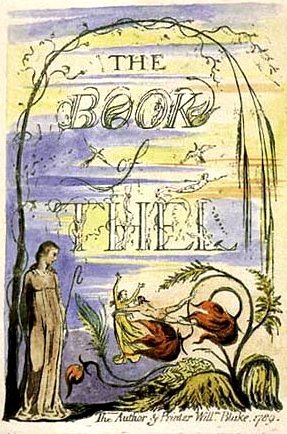
Why fade these children of the spring? born but to smile & fall.
Ah! Thel is like a watery bow, and like a parting cloud;
Like a reflection in a glass; like shadows in the water;
Like dreams of infants,like a smile upon an infants face;
Like the doves voice;like transient day;like music in the air;
Ah! gentle may I lay me down, and gentle rest my head.
And gentle sleep the sleep of death
---Blake
Coined there among
Lonely horizontals
You exist openly.
Our needs hourly
Climb and return like angels.
Unclosing like a hand,
You give for ever.
---Larkin, from 'Solar'
Things are going to slide, slide in all directions.
Won't be nothing
Nothing you can measure any more.
The blizzard, the blizzard of the world
has crossed the threshold
And it has overturned
the order of the soul.
---Leonard Cohen (courtesy of Jonah)
Saturday, January 13, 2007

Old Man
Is, then, He who has created the heavens and the earth not able to create [anew] the like of those [who have died]? Yea, indeed - for He alone is the all-knowing Creator:
His Being alone is such that when He wills a thing to be, He but says unto it, “Be” — and it is.
Limitless, then, in His glory is He in whose hand rests the mighty dominion over all things; and unto Him you all will be brought back!
(Q: 36:81-83)
The verses of the Quran are not merely sentences which transmit thoughts, but are in way beings, powers or talismans. The soul of a Muslim is as it were woven of sacred formulas; in these he works, in these he rests, in these he lives and in these he dies.
--Frithjof Schuon.
It was a grey and overcast day, no different from any other, perhaps. At the cemetery I was struck by how solemn some of the words were: heavy, opaque almost. It was as if they had taken on the inner spirit of the earth itself. What one always marvels at, what never ceases to take one aback in surprise, is how ancient these rituals are -and just how they root us to a timeless deep...they are like anchors that always restore a primordial equilibrium, tearing us away from the historical drama of the self. There is a great comfort in recalling that words must be spoken in a particular way, that highly stylised ritual actions afford a type of freedom that can hardly be imagined in our modern times.
Back home Ubo recited Surah Yasin and his body rocked to and fro as he did; again, one is made aware of how old such recitation methods are and it is only when one listens to a surah do the words come alive; then, and only then, does one feel the inner rhythms of the text, get a dim sense of how different strands of meaning are miraculously woven into the verses. The written word, in comparison, always appears linear, or two dimensional and hardly ever takes flight. The human voice-precisely because it is human-is always more grounded but in hearing the chant one doesn't think of the person. The human voice has become merely a medium and though each may have his unique style this is greatly overshadowed by the presence of the universal. A light may still burn but is nothing in the presence of the sun...
Was listening to Ginsberg the other day and thought to myself: what a fantastic performer. (I have nothing to say on his poetry). When he talked he invariably seemed false, full of himself, but when he sang it was as if he was so much more at ease and the gap between him and the poem narrowed to the thinnest of margins...
We in the west have deliberately turned our back on nature and forged a man-made compromise. Western music has a vibrancy to it , which feeds directly off the tension (between natural and artificial ) in the tuning. ..Western music is fast because it is not in tune. ...it is not in tune with nature, it is incapable of finding a calm, neutral state, so to avoid the discomfort of this situation it keeps moving relentlessly on -it is generating movement because it cannot be at peace with itself.
--Howard Goodall.
For the soul of the Arab is monotonous-but not in a sense of poverty of imagination; he has plenty of that; but his instinct does not go, like that of Western man after width, three-dimensional space and simultaneity of many shades of emotion. Through Arabian music speaks a desire to carry, each time , a single emotional experience to the utmost end of its reach. To this pure monotony, this almost sensual desire to see desire intensified in a continuous, ascending line that Arabian character owes its strengths and its faults. Its faults: for the world want to be experienced , emotionally, in space as well; And its strength: for the faith in the possibility of an endless linear ascent of emotional knowledge can in the sphere of the mind lead nowhere but to God.
--M. Asad, Road to Mecca
His Being alone is such that when He wills a thing to be, He but says unto it, “Be” — and it is.
Limitless, then, in His glory is He in whose hand rests the mighty dominion over all things; and unto Him you all will be brought back!
(Q: 36:81-83)
The verses of the Quran are not merely sentences which transmit thoughts, but are in way beings, powers or talismans. The soul of a Muslim is as it were woven of sacred formulas; in these he works, in these he rests, in these he lives and in these he dies.
--Frithjof Schuon.
It was a grey and overcast day, no different from any other, perhaps. At the cemetery I was struck by how solemn some of the words were: heavy, opaque almost. It was as if they had taken on the inner spirit of the earth itself. What one always marvels at, what never ceases to take one aback in surprise, is how ancient these rituals are -and just how they root us to a timeless deep...they are like anchors that always restore a primordial equilibrium, tearing us away from the historical drama of the self. There is a great comfort in recalling that words must be spoken in a particular way, that highly stylised ritual actions afford a type of freedom that can hardly be imagined in our modern times.
Back home Ubo recited Surah Yasin and his body rocked to and fro as he did; again, one is made aware of how old such recitation methods are and it is only when one listens to a surah do the words come alive; then, and only then, does one feel the inner rhythms of the text, get a dim sense of how different strands of meaning are miraculously woven into the verses. The written word, in comparison, always appears linear, or two dimensional and hardly ever takes flight. The human voice-precisely because it is human-is always more grounded but in hearing the chant one doesn't think of the person. The human voice has become merely a medium and though each may have his unique style this is greatly overshadowed by the presence of the universal. A light may still burn but is nothing in the presence of the sun...
Was listening to Ginsberg the other day and thought to myself: what a fantastic performer. (I have nothing to say on his poetry). When he talked he invariably seemed false, full of himself, but when he sang it was as if he was so much more at ease and the gap between him and the poem narrowed to the thinnest of margins...
We in the west have deliberately turned our back on nature and forged a man-made compromise. Western music has a vibrancy to it , which feeds directly off the tension (between natural and artificial ) in the tuning. ..Western music is fast because it is not in tune. ...it is not in tune with nature, it is incapable of finding a calm, neutral state, so to avoid the discomfort of this situation it keeps moving relentlessly on -it is generating movement because it cannot be at peace with itself.
--Howard Goodall.
For the soul of the Arab is monotonous-but not in a sense of poverty of imagination; he has plenty of that; but his instinct does not go, like that of Western man after width, three-dimensional space and simultaneity of many shades of emotion. Through Arabian music speaks a desire to carry, each time , a single emotional experience to the utmost end of its reach. To this pure monotony, this almost sensual desire to see desire intensified in a continuous, ascending line that Arabian character owes its strengths and its faults. Its faults: for the world want to be experienced , emotionally, in space as well; And its strength: for the faith in the possibility of an endless linear ascent of emotional knowledge can in the sphere of the mind lead nowhere but to God.
--M. Asad, Road to Mecca
Thursday, January 11, 2007
Knowing me, knowing You.
Some people tend to think of formal education as a proof of, or a proxy for, intelligence. This really begs the question: what is an education? Of course, people without schooling can also be thick-that is hardly in doubt and goes without saying; what one needs to be sceptical of is, I think, the notion that institutionalised education is necessarily the same thing as learning.
One can think of all sorts of counter examples : the Germans in the inter-war years, with all of their high culture, art and science, still descended into the most horrid form of madness imaginable. At the personal level, one is aware of people who at the surface level are tremendously clever, sharp as pins in their own field, but have little but a rudimentary knowledge of other subjects; more to the point, their understanding of life is severely limited. It is as if there has been a hypertrophy of the mind in the west. Formal intelligence is one thing, integral intelligence quite another. For who is to say that there isn't intelligence in humour, in understanding that there are ways to say things, times to be silent; that there isn't a sublime intelligence that is expressed in dance, music , art, in knowing what friendship and love are?
Rumi narrates the story...
A king sends his only son off to the best university in his kingdom. After many years of rigorous study the son returns, having acquired the highest degrees and having won all the highest accolades. The father is so proud of him that he wants to demonstrate to his court just how useful a good education is. Unbeknown to his son, the King puts his ring in his hand and clasps it shut so that no-one can see what is in it.
"Tell me son, what do you think is in my hand?"
The son thinks, contemplates for many minutes (for he has studied philosophy at the highest level).
"By the way in which your hand is positioned, and knowing human biology the way I do, I would say that it is round."
The court is startled into silence. "How clever!" and "How wise the King was to send him to that university!"
"What else?", asks the King.
"Well, the way the light is refracted I would say that my knowledge of physics leads me to the conclusion that it is hollow".
Again, there is amazement and wonderment all round.
"And?", says the King.
"I have studied the periodic table for many years and know the truth behind matter. I would say that what you have in your hand is also gold".
The court is stunned. Some fall to the floor. The priests and magicians are all silent.
"Now, wise son, do the formalities ..we now know it is gold, hollow, and round. Reveal to this backward court of mine what is in my hand ."
And with that the son says, "Is it your crown father?"
We may know the world in detail but miss the point, the essential...
There seems to me to be a terrible snobbery associated with higher education. Not only can a theoretical approach to all matters hinder a balanced approach to knowledge (Goethe: often rounded, never complete..broken circles), but it can also alienate one from other people and from life itself. It is not without good reason that Kennen has been completely displaced by Wiesen. It is as if one enters academia to escape the 'practical world' and the ongoing debates about which is more 'real' can never be resolved. All one can do is point out the irrevocable chasm between the two realms: word and deed have, indeed, been torn apart.
At another level, there is a strange fear that we cannot reduce everything to something we can 'know'. The 'totalising' aspect of the mind is, perhaps, the trap of traps...knowledge itself becomes an idol. Wisdom sets bounds to what I want to know (Nietzsche) . Levinas tells the story of Gagarin who, on reaching outer space, the limits of the known, says 'There is no God here'. Levinas' insightful remarks on this are: even at the boundaries man only encounters himself (and this echoes Heisenberg's startling prediction with regards science: there is a danger that man will encounter only the products of his own mind) . And Bertrand Russell could well advocate a 'useless knowledge', a way of understanding the world and life that isn't reduced to, and one that resists, utilitarian ends.
From that time forward [17th c.], the way was open for philosophy either to attain the rigour of the mathematician or the mathematical physicist, or to explain the appearance of rigour in these fields, rather than to help people attain peace of mind. Science, rather than living, became philosophy's subject, and epistemology its centre.
--Rorty.
Notes from Fran O'Rourke, Pseudo-Dinoysius and Aquinas:
One can think of all sorts of counter examples : the Germans in the inter-war years, with all of their high culture, art and science, still descended into the most horrid form of madness imaginable. At the personal level, one is aware of people who at the surface level are tremendously clever, sharp as pins in their own field, but have little but a rudimentary knowledge of other subjects; more to the point, their understanding of life is severely limited. It is as if there has been a hypertrophy of the mind in the west. Formal intelligence is one thing, integral intelligence quite another. For who is to say that there isn't intelligence in humour, in understanding that there are ways to say things, times to be silent; that there isn't a sublime intelligence that is expressed in dance, music , art, in knowing what friendship and love are?
Rumi narrates the story...
A king sends his only son off to the best university in his kingdom. After many years of rigorous study the son returns, having acquired the highest degrees and having won all the highest accolades. The father is so proud of him that he wants to demonstrate to his court just how useful a good education is. Unbeknown to his son, the King puts his ring in his hand and clasps it shut so that no-one can see what is in it.
"Tell me son, what do you think is in my hand?"
The son thinks, contemplates for many minutes (for he has studied philosophy at the highest level).
"By the way in which your hand is positioned, and knowing human biology the way I do, I would say that it is round."
The court is startled into silence. "How clever!" and "How wise the King was to send him to that university!"
"What else?", asks the King.
"Well, the way the light is refracted I would say that my knowledge of physics leads me to the conclusion that it is hollow".
Again, there is amazement and wonderment all round.
"And?", says the King.
"I have studied the periodic table for many years and know the truth behind matter. I would say that what you have in your hand is also gold".
The court is stunned. Some fall to the floor. The priests and magicians are all silent.
"Now, wise son, do the formalities ..we now know it is gold, hollow, and round. Reveal to this backward court of mine what is in my hand ."
And with that the son says, "Is it your crown father?"
We may know the world in detail but miss the point, the essential...
There seems to me to be a terrible snobbery associated with higher education. Not only can a theoretical approach to all matters hinder a balanced approach to knowledge (Goethe: often rounded, never complete..broken circles), but it can also alienate one from other people and from life itself. It is not without good reason that Kennen has been completely displaced by Wiesen. It is as if one enters academia to escape the 'practical world' and the ongoing debates about which is more 'real' can never be resolved. All one can do is point out the irrevocable chasm between the two realms: word and deed have, indeed, been torn apart.
At another level, there is a strange fear that we cannot reduce everything to something we can 'know'. The 'totalising' aspect of the mind is, perhaps, the trap of traps...knowledge itself becomes an idol. Wisdom sets bounds to what I want to know (Nietzsche) . Levinas tells the story of Gagarin who, on reaching outer space, the limits of the known, says 'There is no God here'. Levinas' insightful remarks on this are: even at the boundaries man only encounters himself (and this echoes Heisenberg's startling prediction with regards science: there is a danger that man will encounter only the products of his own mind) . And Bertrand Russell could well advocate a 'useless knowledge', a way of understanding the world and life that isn't reduced to, and one that resists, utilitarian ends.
From that time forward [17th c.], the way was open for philosophy either to attain the rigour of the mathematician or the mathematical physicist, or to explain the appearance of rigour in these fields, rather than to help people attain peace of mind. Science, rather than living, became philosophy's subject, and epistemology its centre.
--Rorty.
Notes from Fran O'Rourke, Pseudo-Dinoysius and Aquinas:
Wednesday, January 10, 2007
Two Words
If anyone else reading this blog would like to put down a few words-on hands or anything else- it would be a pleasure to hear from you.
Celeste writes:
I once wrote a poem consisting of only two words: Hands birdsHands is an image. Birds is an image. Between them, a long wordless flight. Each reverberates in the stillness. The reverberations intermingle. In the centre one begins to pick up the interacting waves of sound and picture. The winged limb at rest and at full stretch. Agility, grace, efficiency, versatility, the power of the small: man's hand; birds. How one may hold another hand in one's own, like a bird, warm soft and perishable, it is held in trust. How one may hold a bird in one's hand, and feel the tender beating savage presence; through all the tenderness one feels as well the predatory claw, the blast off flight, the endurance, the skill.
One could muse forever on hand and bird, how they are similar and different. How they participate in the being of earth, both creatures of a feathered god with a thousand arms.
How hard it is to say anything about the poem without as it were putting handcuffs on the hands and tethers on the birds. If however one utters the word "hands" and then moves in its wake through the stirring stillness to "birds", and the two notes then work their magic simultaneously, the poem begins to live, and to do its work in the listening ear. There is really nothing to say, there is a mood in which quiet meditation seems most full of meaning. Hands birdsOut of such a mood of speechlesness the poem was formed .In the crisis to which life compels us, we search for the form by that which we may best join the world. As we come into touch with other beings, we discover ourselves. This is precise. As I experience the presence of a tree or a field or a stream or another person or a tremor that runs through me with a force of its own, I know myself through that experience. If I turn my glance always inward, I will look into the dark. The dark is real and rich, and it is surely there. But I will know nothing about it by looking into it, for I will see nothing. I will see into the dark only if I look at you. Then the dark will stir, will be stirred by our friction; a light will float like a feather in that dark and my whole being will shake with the creation that then happens.
I think Muhammad Ali once came up with the world's shortest poem. It went something like this (if I remember correctly):
Me. Us.
Celeste writes:
I once wrote a poem consisting of only two words: Hands birdsHands is an image. Birds is an image. Between them, a long wordless flight. Each reverberates in the stillness. The reverberations intermingle. In the centre one begins to pick up the interacting waves of sound and picture. The winged limb at rest and at full stretch. Agility, grace, efficiency, versatility, the power of the small: man's hand; birds. How one may hold another hand in one's own, like a bird, warm soft and perishable, it is held in trust. How one may hold a bird in one's hand, and feel the tender beating savage presence; through all the tenderness one feels as well the predatory claw, the blast off flight, the endurance, the skill.
One could muse forever on hand and bird, how they are similar and different. How they participate in the being of earth, both creatures of a feathered god with a thousand arms.
How hard it is to say anything about the poem without as it were putting handcuffs on the hands and tethers on the birds. If however one utters the word "hands" and then moves in its wake through the stirring stillness to "birds", and the two notes then work their magic simultaneously, the poem begins to live, and to do its work in the listening ear. There is really nothing to say, there is a mood in which quiet meditation seems most full of meaning. Hands birdsOut of such a mood of speechlesness the poem was formed .In the crisis to which life compels us, we search for the form by that which we may best join the world. As we come into touch with other beings, we discover ourselves. This is precise. As I experience the presence of a tree or a field or a stream or another person or a tremor that runs through me with a force of its own, I know myself through that experience. If I turn my glance always inward, I will look into the dark. The dark is real and rich, and it is surely there. But I will know nothing about it by looking into it, for I will see nothing. I will see into the dark only if I look at you. Then the dark will stir, will be stirred by our friction; a light will float like a feather in that dark and my whole being will shake with the creation that then happens.
I think Muhammad Ali once came up with the world's shortest poem. It went something like this (if I remember correctly):
Me. Us.
Free At Last
The great paradox is that we live in times that stress a wildly disproportionate freedom and autonomy (from nature, society) and that, also, encourage us in the same instance to believe that we can explain our lives through science and theoretical reason-as if life itself was nothing but a part of the great mechanical causality that we call 'necessity'.
We say we are free to do what we desire but have no or little inclination of the possibility that we can also be a 'slave of our desires'. We are coaxed into believeing that freedom resides in this and this alone: the ability to choose between competing goods. The allure of a happiness that is an unending increase and not just the entering into an expansive space, an exalted state of being beckons...we are enticed by it, drawn to it...Marx would say that we prefer it to the limited perfection of the ancient world. So, not just the voluptuous seduction of possibilities but the constant running up against limits and obstacles and the overcoming of them is what draws us on. In fact, it is hard to conceive of this type of freedom without the corresponding sense of limitation or constraint.
In the central political tradition of the west there is an irreducible tension between highly valued ideals: freedom, equality, and solidarity. Freedom -thought of as in terms of 'rights'- can lead to grossly unequal outcomes. The right to follow one's own self-interest can be compatible with stark disparities in incomes and yet still be considered 'fair'. At another level, it might be asked if such a freedom to act doesn't sometimes jeopardize social solidarity. Do market exchanges only meet the needs of strangers? Thus, within the political tradition there are disparate sources of value (and this is to put to one side the metaphysical critique of such a limited conception).
Closely following this critique, the conservative might argue that 'passive citizenship'-a concern for trinkets and baubles and a reneging on civic action, a withdrawl into ourselves that is on par with the men and women of late antiquity-is the modern from of democracy and a limited one at that too. The dispiriting implication of this strand of thought being that representative democracy limits each person's ability to act for himself. Inextricably linked to this perceived lack of real freedom is the growth of a mass society in which each person's actions are likely to be inconsequential-even if one were able to disentangle them from the myriad other causal factors behind events. In some sense, we all live in 'welfare states' and the question of power, the freedom to determine one's own life, remains a complex one.
A culture that is dominated by experts , paid specialists who inform us on matters ranging from the environment , style , fashion, diet, economics, seriously undermines the justification for caliming to be enlightened and free from priests and authority. The all-pervasiveness of powerful medias and their ability to generate, manufacture, consent and a climate of opinion considerably weakens our autonomy.
Another dimension of the question rests on the claim that freedom or alienability allows us to think of ourselves as separated from out bodies, other people, and nature. If we can exchange these things then this in no small way depends on our first thinking of them precisely as 'things'. Of course, there can be little doubt that this ability to abstract, to get away from ourselves, has served us well-the question here is really of redressing the balance, and nothing more. What does it mean to think of nature only as a commodity and what are the implications of doing so? Do we impinge on the best view we have of ourselves and other people if we think of them as possessions of the self?
Does the freedom of the desiring self, then, come at the expense of the integrity of being? Behind the notion that freedom is 'willing' is the existential perpsective that holds existence to precede essence, whether the 'given' be God, Nature, or the past. Very rarely do we stop to reflect that existence is given to us and not something of our own making..a pure gift that has to be returned. Our modern views of freedom derive, then, in the last resort, from a reversal of values that places action and 'making' ahead of contemplation.
To say 'the truth shall set you free' is already to relate freedom to something that is higher than it. What would it mean, politically speaking, to think of freedom in connection with the virtues rather than with the ability to choose? This presupposes the broader question of how freedom is linked to value. To the modern mind, the fact that something is freely chosen suggests that it has greater (utility) value but this is quite the opposite of the older way of thinking about things: something is valuable, desirbale, and therefore it will be chosen. In fact, in some cases, when it comes to the good is it even correct to always talk in terms of choice?
The modern concept of freedom must work, in the final analysis, to devalue if not destroy the very idea of intrinsic worth. it is not without reason that economics can only talk in terms of exchange-value and not in terms of worth (see Hannah Arendt, The Human Condition). If we are free to choose then pushpin is as good as poetry said the man. There can be no question of 'tastes' or, if there is, then tastes themselves are considere to be completely arbitrary or subjective.
If we think of freedom in this way, as a series of rebellions against an established order of things, then is it any surprise that there's a pervading sense of cultural exhaustion, that there can be , as George Steiner puts it, no new beginnings? One can dismiss this as cultural pessimism, for sure. But I think a closer look might draw our atention to the deeply nihilistic implications of such a shallow conception of freedom. With Brando, we well might ask: Have you ever considered any real freedoms?
We say we are free to do what we desire but have no or little inclination of the possibility that we can also be a 'slave of our desires'. We are coaxed into believeing that freedom resides in this and this alone: the ability to choose between competing goods. The allure of a happiness that is an unending increase and not just the entering into an expansive space, an exalted state of being beckons...we are enticed by it, drawn to it...Marx would say that we prefer it to the limited perfection of the ancient world. So, not just the voluptuous seduction of possibilities but the constant running up against limits and obstacles and the overcoming of them is what draws us on. In fact, it is hard to conceive of this type of freedom without the corresponding sense of limitation or constraint.
In the central political tradition of the west there is an irreducible tension between highly valued ideals: freedom, equality, and solidarity. Freedom -thought of as in terms of 'rights'- can lead to grossly unequal outcomes. The right to follow one's own self-interest can be compatible with stark disparities in incomes and yet still be considered 'fair'. At another level, it might be asked if such a freedom to act doesn't sometimes jeopardize social solidarity. Do market exchanges only meet the needs of strangers? Thus, within the political tradition there are disparate sources of value (and this is to put to one side the metaphysical critique of such a limited conception).
Closely following this critique, the conservative might argue that 'passive citizenship'-a concern for trinkets and baubles and a reneging on civic action, a withdrawl into ourselves that is on par with the men and women of late antiquity-is the modern from of democracy and a limited one at that too. The dispiriting implication of this strand of thought being that representative democracy limits each person's ability to act for himself. Inextricably linked to this perceived lack of real freedom is the growth of a mass society in which each person's actions are likely to be inconsequential-even if one were able to disentangle them from the myriad other causal factors behind events. In some sense, we all live in 'welfare states' and the question of power, the freedom to determine one's own life, remains a complex one.
A culture that is dominated by experts , paid specialists who inform us on matters ranging from the environment , style , fashion, diet, economics, seriously undermines the justification for caliming to be enlightened and free from priests and authority. The all-pervasiveness of powerful medias and their ability to generate, manufacture, consent and a climate of opinion considerably weakens our autonomy.
Another dimension of the question rests on the claim that freedom or alienability allows us to think of ourselves as separated from out bodies, other people, and nature. If we can exchange these things then this in no small way depends on our first thinking of them precisely as 'things'. Of course, there can be little doubt that this ability to abstract, to get away from ourselves, has served us well-the question here is really of redressing the balance, and nothing more. What does it mean to think of nature only as a commodity and what are the implications of doing so? Do we impinge on the best view we have of ourselves and other people if we think of them as possessions of the self?
Does the freedom of the desiring self, then, come at the expense of the integrity of being? Behind the notion that freedom is 'willing' is the existential perpsective that holds existence to precede essence, whether the 'given' be God, Nature, or the past. Very rarely do we stop to reflect that existence is given to us and not something of our own making..a pure gift that has to be returned. Our modern views of freedom derive, then, in the last resort, from a reversal of values that places action and 'making' ahead of contemplation.
To say 'the truth shall set you free' is already to relate freedom to something that is higher than it. What would it mean, politically speaking, to think of freedom in connection with the virtues rather than with the ability to choose? This presupposes the broader question of how freedom is linked to value. To the modern mind, the fact that something is freely chosen suggests that it has greater (utility) value but this is quite the opposite of the older way of thinking about things: something is valuable, desirbale, and therefore it will be chosen. In fact, in some cases, when it comes to the good is it even correct to always talk in terms of choice?
The modern concept of freedom must work, in the final analysis, to devalue if not destroy the very idea of intrinsic worth. it is not without reason that economics can only talk in terms of exchange-value and not in terms of worth (see Hannah Arendt, The Human Condition). If we are free to choose then pushpin is as good as poetry said the man. There can be no question of 'tastes' or, if there is, then tastes themselves are considere to be completely arbitrary or subjective.
If we think of freedom in this way, as a series of rebellions against an established order of things, then is it any surprise that there's a pervading sense of cultural exhaustion, that there can be , as George Steiner puts it, no new beginnings? One can dismiss this as cultural pessimism, for sure. But I think a closer look might draw our atention to the deeply nihilistic implications of such a shallow conception of freedom. With Brando, we well might ask: Have you ever considered any real freedoms?
Sunday, January 07, 2007
Chances are
The problem with reading anyone's blog is that you always have to start at the end, reading their life backwards. It's like watching a murder-mystery: you know how it ends but you think to yourself: how did it all begin...
A life is understood backwards, but lived forwards.
---Kierkegaard
Columbo would always know who did it and why they did it; the end was always a foregone conclusion; the only remaining mystery is how we slip up...
Ubo would say: I wish, just once, Columbo would fall flat on his face. Life without any chances is plain dull. Echoing the Allama, he would add: the problem of this world is that it is limited; the problem of the next is that it doesn't have limits.
The "about me" page on blogs always has this hideous section "industry". What a joke! Capitalism at its best! Yes, the teaching industry...the leisure industry...what Adorno called 'organized freedom'. That, along with "astrological sign" is supposed to say something about you! Repeat after me: I am not a number, I am not..
Is it true that modern freedoms are morphing into obsessive compulsion disorders, behaviours that one can only liken to addictions: food, drink, drugs, gambling? The desire to introduce 'risk' and chance back into life is all the more acutely felt as our lives become more predictable. Modern man is caught between a blind mechanism and blind chance.
From today's paper, Tim Adams writing in The Observer, 7 th January:
Whether they won or lost, however, the men remained almost entirely expressionless, as if fascinated by the mechanism itself.
Gloria Steinem once observed that 'women's total instinct for gambling is satisfied by marriage'
Some world-class cynicism:
"It is government-wide policy, and that includes HMT [Her Majesty's Treasury], that Britain should become a world leader in the field of online gambling, in order to provide our citizens with the opportunity to gambling [sic] in a safe, well-regulated environment." [Richard Cabon, Government Minister]
Traditional opposition to gambling, which brought about the 1906 act that sought to ban off-course betting, based its argument not on the fact that it was addictive behaviour but that it fostered a damaging belief in the randomness of reward. Winnings had no relation to effort or worth. Gambling undermined the bond between hard work, thrift and prosperity; it generated a pathology of inequality.
If there was one dominant theme of the Nineties, it was that money could arrive with no warning, apparently at random, in the form of share windfalls, or to fat cats, or property speculators, or footballers, or employees of Goldman Sachs. This combined with plummeting faith in politicians and institutions helped to create a sense that wealth and power were distributed almost by chance.
A life is understood backwards, but lived forwards.
---Kierkegaard
Columbo would always know who did it and why they did it; the end was always a foregone conclusion; the only remaining mystery is how we slip up...
Ubo would say: I wish, just once, Columbo would fall flat on his face. Life without any chances is plain dull. Echoing the Allama, he would add: the problem of this world is that it is limited; the problem of the next is that it doesn't have limits.
The "about me" page on blogs always has this hideous section "industry". What a joke! Capitalism at its best! Yes, the teaching industry...the leisure industry...what Adorno called 'organized freedom'. That, along with "astrological sign" is supposed to say something about you! Repeat after me: I am not a number, I am not..
Is it true that modern freedoms are morphing into obsessive compulsion disorders, behaviours that one can only liken to addictions: food, drink, drugs, gambling? The desire to introduce 'risk' and chance back into life is all the more acutely felt as our lives become more predictable. Modern man is caught between a blind mechanism and blind chance.
From today's paper, Tim Adams writing in The Observer, 7 th January:
Whether they won or lost, however, the men remained almost entirely expressionless, as if fascinated by the mechanism itself.
Gloria Steinem once observed that 'women's total instinct for gambling is satisfied by marriage'
Some world-class cynicism:
"It is government-wide policy, and that includes HMT [Her Majesty's Treasury], that Britain should become a world leader in the field of online gambling, in order to provide our citizens with the opportunity to gambling [sic] in a safe, well-regulated environment." [Richard Cabon, Government Minister]
Traditional opposition to gambling, which brought about the 1906 act that sought to ban off-course betting, based its argument not on the fact that it was addictive behaviour but that it fostered a damaging belief in the randomness of reward. Winnings had no relation to effort or worth. Gambling undermined the bond between hard work, thrift and prosperity; it generated a pathology of inequality.
If there was one dominant theme of the Nineties, it was that money could arrive with no warning, apparently at random, in the form of share windfalls, or to fat cats, or property speculators, or footballers, or employees of Goldman Sachs. This combined with plummeting faith in politicians and institutions helped to create a sense that wealth and power were distributed almost by chance.
Subscribe to:
Posts (Atom)


