Thursday, January 31, 2008
The End
My spiritual advisor has told me to stop writing and make my way home. She says it is a waste of time and I should focus on the one thing needful. So, just to remind her, I will sing my name, and I will find my way home..

Tuesday, January 29, 2008
The Path

About 100,000 years ago I must certainly have been related to swans and wild geese, because I feel so drawn towards them.
----To Jussi Jalas, 24th August 1940
----To Jussi Jalas, 24th August 1940
Faith, like a bird, sees its trackless way, unaided by the intellect.
----Farid.
A white sheet of paper is full of ways.
Old people have walked down the path so often that it ceases to be a path-and they, themselves, have become invisible. V.S.P's.'Life at 80' is sublime on this. Dying people see it. Theirs is a late style . The threads of time become the curves of time.
'Architecture for me has always begun with drawing. When I was very little my mother said I used to draw in the air with my fingers. I needed a pencil. Once I could hold one, I have drawn every day since. The buildings do appear on paper the way you say, but they are not the result of gratuitous brushstrokes. The pencil is guided by so many thoughts stored away in my mental library. But, when I have looked at the site for a building, considered its budget and thought of how it might be built, and what it might be, the drawings come very quickly. I pick up my pen. It flows. A building appears. There it is. There is nothing more to say...
When people ask me if I take pleasure in the idea of someone looking at my buildings in the future, I tell them that this person will vanish, too. Everything has a beginning and an end. You. Me. Architecture. We must try to do the best we can, but must remain modest. Nothing lasts for very long...'
Right angles separate and divide. Personally, I have always loved curves, which are an essential feature of the natural world. It is not easy to draw curves, to give them the spontaneity they demand and then to organize them in space in such a way as to achieve the visual architectural effect that one is looking for. Like Matisse, I maintain that my curves are not gratuitous; they have a meaning. At one point, even Le Corbusier, who had proclaimed the virtues of right angles, began to despise them. In the end he admitted that we were right. One day he said to me: What you do is baroque, but you do it very well. You have the mountains of Rio in your eyes.'
----Oscar Niemeyer (still working at the age of 100!)
From the New Yorker:
Sibelius, For an instant God opens up his door and His orchestra plays the fifth symphony.
The 8th, started in 1924, remains uncompleted even though he worked on it up until the time of his death, 1957. Life is soon over. Others will come and surpass me in the eyes of the world. We are fated to die forgotten. I must start economizing. It can't go on like this.
He burns his manuscripts. What must it be like to lose one's work like this (Huxley?). Is there a desire to be unknown, to not be named, that rivals the desire to be an immortal, a star that resists the withering hand of time? Remember, he comes from the outskirts. The human scale of the other, smaller, marginal Europe (Kundera)
Rachmaninoff: I cannot cast out the old way of writing, and I cannot acquire the new. I have made intense effort to feel the musical manner of today, but it will not come to me.
'The Finns are descendants of an errant tribe'. Mahler: The symphony must be like the world. It must be all-embracing. Sibelius: A confession of faith at different stages of one's life.
The 5th: repetition of themes with small variations. 'Music becomes a search for meaning with an open-ended structure-an analogue to the spiritual life.
2nd movement: the swan hymn: 16 swans flying over Ainola: One of my greatest experiences! Lord God, that beauty! They circled over me for a long time. Disappeared into the solar haze like a gleaming, silver ribbon..That this should have happened to me, who have so long been the outsider..nothing in the whole world affects me-nothing in art, literature, or music-in the same way as do these swans and wild geese and cranes. Their voices and being.
'The swan hymn transcends the depiction of nature: it is like a spiritual force in animal form. When the horns introduce the theme..it's as if they had always been playing it, and the listener had only begun to hear it. Its intervals split wide open, shatter and re-form.
The symphony ends with six far-flung chords , through which the main theme shoots like a pulse of energy. The swan becomes the sun.'
Three days before his death he would walk in the forest, awaiting the return of the cranes, hoping to relive that moment. To be a radical in this day and age is to be a conservative, to retrace ancient byways, to draw invisible lines. Even if the path cannot be discerned any more, still it is worth living just to know that it once existed, that it was open for each one of us, and that for time out of mind you and I have glimpsed it and gasped at such a spectacular vision.
Their cries echo throughout my being. One of them broke from the flock, circled the house, cried out, and flew away....
Glitter and Doom
----Gramsci
~
This is probably the shallowest Reith Lecture I have ever heard; here was J.Sachs with his unbounded optimism addressing an old-world European audience steeped in cynicism and full to the brim with black thoughts. Invoking the names of J.F.K. and Adam Smith hardly endeared him to anyone and talking of Nick Stern as a "hero of our time" produced guffaws of laughter. To top it all, former spice Girl what's-her-name-was asked to comment. Yeah, like, we should like have more women's empowerment.
~
Sachs seemed to warm to such jargon. Yes, we must get people on the "development ladder," "eradicate poverty" and so on. And who would bear the costs of these world-shaking solutions? That's the beauty, he adds..the rich don't have to sacrifice that much, the technology allows one to make real choices on the cheap. What can one expect from an algebraic mindset. Economists and engineers know a few tricks: technical problem, technical solution.
~
~
Do we still live in a world?.
As in Late Antiquity, we live in a time that is devoid of the world. The modern age starts not with a return to the world but with inner-worldliness (Descartes). In fact, there is a contempt for the world, for what is "mere matter" or extension. Only the glittering soul within is free in a world given over to law, mechanism (satanic mills) and doom. We, the modern gnostics, are on a voyage, the second turning inwards (Hannah); this culminates with Hopper where the great American frontier has now moved inwards.
.
Capitalism is not a triumph of "the west" or of "Europe" but of abstract space and time over lived space and time. From now on place can only be parochial, myopic. The Red Man saw this with uncanny clarity: you have sacrificed the earth's slow wisdom for speed. China and India will find that they are defeated even as they win. The future isn't red..it is grey.
~
As in Late Antiquity, we live in a time that is devoid of the world. The modern age starts not with a return to the world but with inner-worldliness (Descartes). In fact, there is a contempt for the world, for what is "mere matter" or extension. Only the glittering soul within is free in a world given over to law, mechanism (satanic mills) and doom. We, the modern gnostics, are on a voyage, the second turning inwards (Hannah); this culminates with Hopper where the great American frontier has now moved inwards.
.
Capitalism is not a triumph of "the west" or of "Europe" but of abstract space and time over lived space and time. From now on place can only be parochial, myopic. The Red Man saw this with uncanny clarity: you have sacrificed the earth's slow wisdom for speed. China and India will find that they are defeated even as they win. The future isn't red..it is grey.
~
And the leveling of all distinctions continues. The aspirations of "the poor" must be to be like you cousin Louis, brother Sachs. What is left, then, of politics but a post-politics, what Foucault would call the 'administration of things', the management, regulation and enhancing of Life? Here it is not life as bios, but zoe, pure, naked life of the body. Politics is the calculus of pleasure and pain. What is important now is the bourgeois excess of life, this is the new infinity, the new 'political' dimension: the right to happiness is both what the political system is supposed to guarantee (and how it is evaluated) but also a goal that is unattainable.
~
Under such circumstances the world disappears. 'Instant living'. Hannah Arendt: once labour is admitted into the political realm, once it becomes the main focus of politics (household economics) then how to establish continuity, how to bind people who are concerned about their own private pleasures and pain-things that can never be communicated except as a spectacle?
.
Permitted jouissance turns into obligatory jouissance.
.
You must, because you can...a life of excessive pleasure or a universalized principle of pleasure..there is nothing else.~
And yet, a radical, excessive pleasure would destroy all social limits, constraints, norms. This, at heart, is the cultural contradiction of capitalism..what Tawney would say corresponds to the divine frenzy. The commodity doesn't deliver..it is never meant to. It is the allure of happiness, the promise of a bliss that it holds out to the imagination that we find so enticing. At the heart of each commodity is a hole or, like a mirage, when we reach it we realise it isn't what we thought it was...
.
The drive to a pure autistic jouissance (through drugs or other trance-induced means) arose at a precise political juncture..At this moment the only option left was a direct, brutal passage a l'acte, push-toward-the Real..
Extreme sexual jouissance, terrorism, or (oriental) inner experience. One cannot but help think back to the twenties. A withdrawal from socio-political engagement into a direct contact with the Real. But this has come and passed and now there is only indifference. One thinks back to the exhaustion of the Seventies and the beginnings of a whole retro culture, as if we were witnessing the End of History. From now on: deja vu, the uncanny, Groundhog Day. But hasn't bourgeois culture always been in a crisis? When hasn't there been talk about the Last Days of Mankind, the Decline of the West? Perhaps this is a story the moderns like telling themselves..the story of how all stories came to an end.
~
Capitalism's ontological importance is its ability to lead to the desacralization of all sacred bonds, undermining every stable form of representation. All that is solid melts into air...
.
The crowd is just a mass of individuals. As Guenon saw a long time ago: in the Reign of Quantity society is the same thing as the individual. Modern technologies (the Internet) only enhance the trends of the century of the self: solipsistic, churning out anxieties. Sachs again: we live in a connected world. Do we?
~
The problem of leisure: when there are no limits to overcome how do we kill time? What happens when the shock of the new doesn't shock? The pictures from Abu Ghraib look vaguely familiar, the Towers elicit the response: I thought we were watching a movie. As Hannah acutely observes, after Auschwitz the unimaginable has become imaginable, the impossible has become possible. Are we now living in a worldless space, where interior/exterior, centre/periphery distinctions become less valid? Are we now living in a Long Sunday?
~
Under such circumstances the world disappears. 'Instant living'. Hannah Arendt: once labour is admitted into the political realm, once it becomes the main focus of politics (household economics) then how to establish continuity, how to bind people who are concerned about their own private pleasures and pain-things that can never be communicated except as a spectacle?
.
Permitted jouissance turns into obligatory jouissance.
.
You must, because you can...a life of excessive pleasure or a universalized principle of pleasure..there is nothing else.~
And yet, a radical, excessive pleasure would destroy all social limits, constraints, norms. This, at heart, is the cultural contradiction of capitalism..what Tawney would say corresponds to the divine frenzy. The commodity doesn't deliver..it is never meant to. It is the allure of happiness, the promise of a bliss that it holds out to the imagination that we find so enticing. At the heart of each commodity is a hole or, like a mirage, when we reach it we realise it isn't what we thought it was...
.
The drive to a pure autistic jouissance (through drugs or other trance-induced means) arose at a precise political juncture..At this moment the only option left was a direct, brutal passage a l'acte, push-toward-the Real..
Extreme sexual jouissance, terrorism, or (oriental) inner experience. One cannot but help think back to the twenties. A withdrawal from socio-political engagement into a direct contact with the Real. But this has come and passed and now there is only indifference. One thinks back to the exhaustion of the Seventies and the beginnings of a whole retro culture, as if we were witnessing the End of History. From now on: deja vu, the uncanny, Groundhog Day. But hasn't bourgeois culture always been in a crisis? When hasn't there been talk about the Last Days of Mankind, the Decline of the West? Perhaps this is a story the moderns like telling themselves..the story of how all stories came to an end.
~
Capitalism's ontological importance is its ability to lead to the desacralization of all sacred bonds, undermining every stable form of representation. All that is solid melts into air...
.
The crowd is just a mass of individuals. As Guenon saw a long time ago: in the Reign of Quantity society is the same thing as the individual. Modern technologies (the Internet) only enhance the trends of the century of the self: solipsistic, churning out anxieties. Sachs again: we live in a connected world. Do we?
~
The problem of leisure: when there are no limits to overcome how do we kill time? What happens when the shock of the new doesn't shock? The pictures from Abu Ghraib look vaguely familiar, the Towers elicit the response: I thought we were watching a movie. As Hannah acutely observes, after Auschwitz the unimaginable has become imaginable, the impossible has become possible. Are we now living in a worldless space, where interior/exterior, centre/periphery distinctions become less valid? Are we now living in a Long Sunday?
~
No, not quite. Things are never as bleak as theorists make out. You've been watching too much Bergman. Less valid? Yes. But the world is still the world, friendship and love, duty and compasssion and a thousand other things are still with us. Is this still not the tent of scattered stars that love has made?
.
One size fits all...Enjoy!.
--quotes from Zizek, Parallax View.
.
One size fits all...Enjoy!.
--quotes from Zizek, Parallax View.
~
~
From Harper's:
.
The old and the unworldly had the worst of it. Many were driven to begging, many to suicide. The young and the quick-witted did well. Overnight, they became free, rich and independent. It was a situation in which mental inertia and reliance on past experience were punished by starvation and death, but rapid appraisal of new situations and speed of reaction were rewarded with sudden vast riches. The twenty-one-year-old bank director appeared on the scene and also the high-school senior who earned his living from the stock-market tips of his slightly older friends...
.
Amid all the misery, despair, and poverty there was an atmosphere of light-headed youthfulness, licentiousness and carnival. Now, for once the young had money and the old did not. Moreover, its nature had changed. Its value lasted only a few hours. It was spent as never before and never since; and not on the things only old people spend their money on. Bars and nightclubs opened in large numbers. Young couples whirled about the streets of the amusement quarters. Everyone was hectically, feverishly, searching for love and seizing it without a second thought. Indeed, even love had assumed an inflationary character.
---from Sebastian Hafner, Defying Hitler.
.
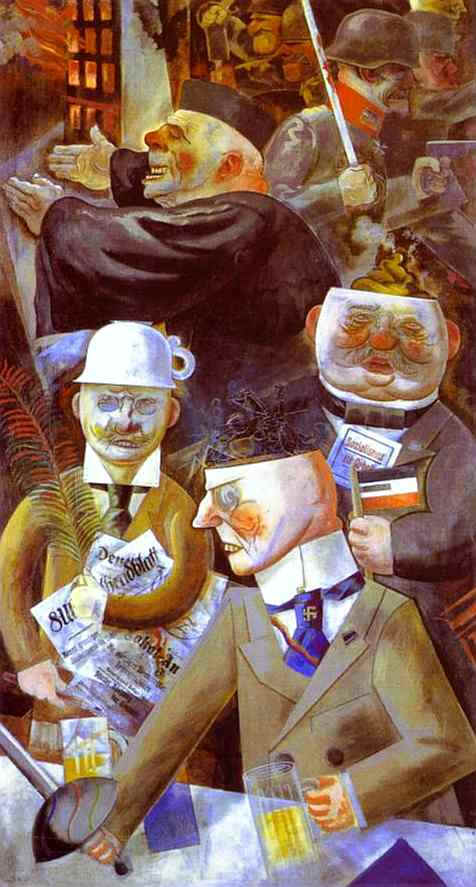
The gaze: as if we were searching for our neighbours' faces to see how human beings still looked. (The deep, inward-looking gaze of the portraits of Late Antiquity). The Verists: fascination with anonymous cripples and prostitutes, cocaine-addicted performers, marginals of all shapes and sizes, delinquents, degenerates and criminals..all elicited the unflinching gaze: to locate the grotesque in everyday urban life and in the faces of the respectable and criminal alike. The beast was within, not on the frontiers and the desire to learn to out stare nothingness, look into the eyes of Medusa, was a sort of intoxication.
~
A fierce sincerity..to mirror the world, including the perverse, nocturnal creatures hitherto excluded. To map the soul of the theatrical self, the so-called pillars of society with their absurd pretension.
.
At the same time, an acute awareness that they were at a historical juncture, a threshold. At such frontiers all sorts of people cross paths: the fabulously rich and the war veteran begging for money. And this scene is repeated today outside the favelas. Here, in a moment, the wounded cross paths with the gluttonous.
.
And still we push on , with our 'development ladders' (one billion people live in slums, three people have as much money as the poorest 48 nations). Platzangst: the illusion that one has made no progress while one has been attempting to cross a vast, unending square. The problem for the moderns is that they worry, to paraphrase Gertrude Stein, that there is no there there.
.
The old and the unworldly had the worst of it. Many were driven to begging, many to suicide. The young and the quick-witted did well. Overnight, they became free, rich and independent. It was a situation in which mental inertia and reliance on past experience were punished by starvation and death, but rapid appraisal of new situations and speed of reaction were rewarded with sudden vast riches. The twenty-one-year-old bank director appeared on the scene and also the high-school senior who earned his living from the stock-market tips of his slightly older friends...
.
Amid all the misery, despair, and poverty there was an atmosphere of light-headed youthfulness, licentiousness and carnival. Now, for once the young had money and the old did not. Moreover, its nature had changed. Its value lasted only a few hours. It was spent as never before and never since; and not on the things only old people spend their money on. Bars and nightclubs opened in large numbers. Young couples whirled about the streets of the amusement quarters. Everyone was hectically, feverishly, searching for love and seizing it without a second thought. Indeed, even love had assumed an inflationary character.
---from Sebastian Hafner, Defying Hitler.
.
The gaze: as if we were searching for our neighbours' faces to see how human beings still looked. (The deep, inward-looking gaze of the portraits of Late Antiquity). The Verists: fascination with anonymous cripples and prostitutes, cocaine-addicted performers, marginals of all shapes and sizes, delinquents, degenerates and criminals..all elicited the unflinching gaze: to locate the grotesque in everyday urban life and in the faces of the respectable and criminal alike. The beast was within, not on the frontiers and the desire to learn to out stare nothingness, look into the eyes of Medusa, was a sort of intoxication.
~
A fierce sincerity..to mirror the world, including the perverse, nocturnal creatures hitherto excluded. To map the soul of the theatrical self, the so-called pillars of society with their absurd pretension.
.
At the same time, an acute awareness that they were at a historical juncture, a threshold. At such frontiers all sorts of people cross paths: the fabulously rich and the war veteran begging for money. And this scene is repeated today outside the favelas. Here, in a moment, the wounded cross paths with the gluttonous.
.
And still we push on , with our 'development ladders' (one billion people live in slums, three people have as much money as the poorest 48 nations). Platzangst: the illusion that one has made no progress while one has been attempting to cross a vast, unending square. The problem for the moderns is that they worry, to paraphrase Gertrude Stein, that there is no there there.
Monday, January 28, 2008
Black Sun

Pleasure is fundamentally the intensified awareness of reality, and springs from a passionate openness to the world and love of it.
---Hannah Arendt
~
I think that that is my favourite one line from Hannah and I don't think I'd swap it for anything else. I can understand the darkness, the bitterness of people who have had to go through terrible, unbearable pain, grief or loss. And there's a sadness which, like the snow in Ireland, is general all over. And perhaps without religion and her mysteries, without a living contact with nature, we find all types of subsitute forms that can answer this need for depth, for profundity. But I can't help but think that a part of this morose spirit is fake, is really self-inflicted, and quite needless and probably pointless as well (Beth's point).
~
I was going to write about costume and fashion and its relation to capitalism (loads of Braudel quotes) but my attention was caught by something someone said about grace-and what use are the words of philosophers, historians, or theologians to me in this regard? What is the point of talking about grace from the outside?
.
There are levels of grace, a hierarchy of them. One says grace for the food one receives, one can recognize the grace of a dancer; in both it seems there is the sense of proportion, a recognition of balance. Equally, there is a sense of gift and reciprocity, one might even say etiquette: one has the good grace to accept or return a compliment. The gifted artist gives something of his gifts away and this leads to us being thankful for being brought into the circle of admirers
.
However, on the other hand, is it not the case that grace is completely disproportionate to what we expect or can comprehend? So, whilst grace is the very ability to be thankful for what is not ours (Rumi would say free will is the capacity to be thankful for God's Beneficence) is it also not an awareness that our response will always be lacking?
.
Two further points. I don't think one can ever reflect on grace without the notion of thankfulness. To 'truly bless', as Auden might say, is not such an easy thing. Many are stuck in 'la'. For the entirely self-made man nothing is 'given', all is possessed or coveted. Only an awareness of what is given to us -life itself-can lead to grace. Secondly, is grace the ability to not be weighed down by our own gravity? Grace is a 'descent' but by it being so it allows an ascent-and that too is a recognition of something beyond one's narrow horizons: lightness , in both senses of the word
There are levels of grace, a hierarchy of them. One says grace for the food one receives, one can recognize the grace of a dancer; in both it seems there is the sense of proportion, a recognition of balance. Equally, there is a sense of gift and reciprocity, one might even say etiquette: one has the good grace to accept or return a compliment. The gifted artist gives something of his gifts away and this leads to us being thankful for being brought into the circle of admirers
.
However, on the other hand, is it not the case that grace is completely disproportionate to what we expect or can comprehend? So, whilst grace is the very ability to be thankful for what is not ours (Rumi would say free will is the capacity to be thankful for God's Beneficence) is it also not an awareness that our response will always be lacking?
.
Two further points. I don't think one can ever reflect on grace without the notion of thankfulness. To 'truly bless', as Auden might say, is not such an easy thing. Many are stuck in 'la'. For the entirely self-made man nothing is 'given', all is possessed or coveted. Only an awareness of what is given to us -life itself-can lead to grace. Secondly, is grace the ability to not be weighed down by our own gravity? Grace is a 'descent' but by it being so it allows an ascent-and that too is a recognition of something beyond one's narrow horizons: lightness , in both senses of the word
.
Perhaps we humans,
have wanted God most as a witness
to acts of choice made in solitude.
Acts of memory,
of sacrifice. Wanted
that great single eye to see us ,
steadfast as we flowed by.
Yet there are other acts
not even vanity,
or anxious hope to please, knows of-
bone doings, leaps of nerves, heart-
cries of communion: if there is bliss
it has been already
and will be; out -
reaching, utterly
Blind
to itself,
flooded
with otherness
have wanted God most as a witness
to acts of choice made in solitude.
Acts of memory,
of sacrifice. Wanted
that great single eye to see us ,
steadfast as we flowed by.
Yet there are other acts
not even vanity,
or anxious hope to please, knows of-
bone doings, leaps of nerves, heart-
cries of communion: if there is bliss
it has been already
and will be; out -
reaching, utterly
Blind
to itself,
flooded
with otherness
Sunday, January 27, 2008
Conquistador of the Useless
Are you happy?
Er..why do you ask?
Dunno. Just like that.
Guess I was until I had to think about it!
Perhaps there's something in the soul that hankers for darkness, that desires to be lost in something that is totally foreign to itself. But it's impossible to think that way when one is surrounded by light (wish I'd brought The First Man with me now) . All this striving for narrow confines, all this melancholic brooding, is beginning to become a touch boring (I can only imagine the Internet leading to an expansion of self-pity and introspection).
What is it?
You ask too many questions!
Perhaps you find the world trivial, people superficial, life a bit fake..not quite the real thing.
Perhaps you find the world full of meaningless suffering, inexplicable contingencies. Understandable. No one can think otherwise, no-one can live like a Stoic. But there are escapes, and then there are escapes....
Why do I watch a film expecting it to be profound, something deep, something that will move me? Is it to fill some vacuum? Isn't that what we expect of all art? (Plato, that old wahabi, might have something to say on that!) . Why do we think eccentricity, madness, is the only form of genius, the only thing worth talking about (The Romantic legacy, perhaps)? What would it mean to have sound instincts, to live heartily, with attachments and bonds-and not as an exile, as a fanatic, estranged from one's life, one's times? (Roberto Calasso is brilliant here : the American woodsman as the future, the cowboy who "discovers" the frontier", the colonialist who from inner boredom is compelled to go "where no man has gone before", the 'settler' who sees only wasteland where there is the Red Man, the Palestinian...).
What could be worse than having simple desires, what could be more difficult than saying 'Yes!' to life. Not only must we live with the void, and not be too hasty in filling it with our own private fantasies, remedies, but we must also recognize that to see only the void is not right-seeing and is an act of profound and startling ingratitude.
In the deserts of the heart
Let the healing fountain start,
In the prison of his days
Teach the free man how to praise
W.H. Auden
There will be blood.
What utter crap!
Fitzcarraldo.
What utter crap!
No, Hollywood always/usually trumps because it shows real people. For similar reasons, all this Sufi jargon and 'mysticism' seems, to my mind at least, to miss the point. We have to speak about our times, and in our language. I'm sure all this convoluted thought of the Europeans is very intelligent at its own level, but please, give me a break...what price naivete and what would we give for some solid English writing, for some pragmatism to dispel the hold of these evenings of the mind ?
'Life, at all times full of pain, is more painful than the two centuries that preceded it. The attempt to escape from pain drives men to triviality, to self-deception, to the invention of vast collective myths. But these momentary alleviations do but increase the source of suffering in the long run. Both private and public misfortune can only be mastered by a process in which will and intelligence interact: the part of will is to refuse to shirk the evil or accept an unreal solution, while the part of the intelligence is to understand it, to find a cure if it is curable, and, if not, make it bearable by seeing it in its relations, accepting it as unavoidable, and remembering what lies outside it in other regions, other ages, and the abysses of interstellar space.'
---Useless Knowledge.
This is one of my favourite passages, and is full of homely wisdom, good advice. But something else holds my attention today. Yesterday, at the Sunday market, amidst the onions and carrots, the plastic baskets and smuggled crockery (which was spelt crochery) was a small book stall. Most of the stuff was Sidney Sheldon and Harold Robbins (man, they're really popular here!) but there was also a dusty, well-worn copy of old Russell. How amazing that one can find such things amongst the necessities of the world! In it were underlined the following words:
Er..why do you ask?
Dunno. Just like that.
Guess I was until I had to think about it!
Perhaps there's something in the soul that hankers for darkness, that desires to be lost in something that is totally foreign to itself. But it's impossible to think that way when one is surrounded by light (wish I'd brought The First Man with me now) . All this striving for narrow confines, all this melancholic brooding, is beginning to become a touch boring (I can only imagine the Internet leading to an expansion of self-pity and introspection).
What is it?
You ask too many questions!
Perhaps you find the world trivial, people superficial, life a bit fake..not quite the real thing.
Perhaps you find the world full of meaningless suffering, inexplicable contingencies. Understandable. No one can think otherwise, no-one can live like a Stoic. But there are escapes, and then there are escapes....
Why do I watch a film expecting it to be profound, something deep, something that will move me? Is it to fill some vacuum? Isn't that what we expect of all art? (Plato, that old wahabi, might have something to say on that!) . Why do we think eccentricity, madness, is the only form of genius, the only thing worth talking about (The Romantic legacy, perhaps)? What would it mean to have sound instincts, to live heartily, with attachments and bonds-and not as an exile, as a fanatic, estranged from one's life, one's times? (Roberto Calasso is brilliant here : the American woodsman as the future, the cowboy who "discovers" the frontier", the colonialist who from inner boredom is compelled to go "where no man has gone before", the 'settler' who sees only wasteland where there is the Red Man, the Palestinian...).
What could be worse than having simple desires, what could be more difficult than saying 'Yes!' to life. Not only must we live with the void, and not be too hasty in filling it with our own private fantasies, remedies, but we must also recognize that to see only the void is not right-seeing and is an act of profound and startling ingratitude.
In the deserts of the heart
Let the healing fountain start,
In the prison of his days
Teach the free man how to praise
W.H. Auden
There will be blood.
What utter crap!
Fitzcarraldo.
What utter crap!
No, Hollywood always/usually trumps because it shows real people. For similar reasons, all this Sufi jargon and 'mysticism' seems, to my mind at least, to miss the point. We have to speak about our times, and in our language. I'm sure all this convoluted thought of the Europeans is very intelligent at its own level, but please, give me a break...what price naivete and what would we give for some solid English writing, for some pragmatism to dispel the hold of these evenings of the mind ?
'Life, at all times full of pain, is more painful than the two centuries that preceded it. The attempt to escape from pain drives men to triviality, to self-deception, to the invention of vast collective myths. But these momentary alleviations do but increase the source of suffering in the long run. Both private and public misfortune can only be mastered by a process in which will and intelligence interact: the part of will is to refuse to shirk the evil or accept an unreal solution, while the part of the intelligence is to understand it, to find a cure if it is curable, and, if not, make it bearable by seeing it in its relations, accepting it as unavoidable, and remembering what lies outside it in other regions, other ages, and the abysses of interstellar space.'
---Useless Knowledge.
This is one of my favourite passages, and is full of homely wisdom, good advice. But something else holds my attention today. Yesterday, at the Sunday market, amidst the onions and carrots, the plastic baskets and smuggled crockery (which was spelt crochery) was a small book stall. Most of the stuff was Sidney Sheldon and Harold Robbins (man, they're really popular here!) but there was also a dusty, well-worn copy of old Russell. How amazing that one can find such things amongst the necessities of the world! In it were underlined the following words:
Whatever we may think, we are creatures of Earth, and we draw our nourishment from it just as the plants and animals do. The rhythm of Earth life is slow; autumn and winter are essential to it as summer and spring, the rest is as essential as motion. To the child, even more to than the man, it is necessary to preserve some contact with the ebb and flow of terrestial life. The human body has been adapted throughout the ages to this rhythm, and religion has embodied something of it in the festival of Easter....
Many pleasures, of which we may take gambling as a good example, have in them no element of this contact with the Earth. Such pleasures, in the instant when they cease, leave a man feeling dusty and dissatisfied, hungry for he knows not what....
The special kind of boredom from which modern urban populations suffer is intimately bound up with their separation from the life of Earth. It makes life hot and dusty and thirsty, like a pilgrimage in the desert. A happy life must be a quiet life, for it is only in an atmosphere of quiet that true joy can live.
Friday, January 25, 2008
Disappearing World

By the end of the 19th century the gestures of the western bourgeoisie were irretrievably lost.
'In the cinema , a society that has lost its gestures seeks to re-appropriate what it has lost while simultaneously recording that loss. An era that has lost its gestures is, for that very reason, obsessed with them (The Marlboro Man as an image of coolness, courage). 'Bourgeois man's move to interiority, psychology.Silent cinema: the attempt to evoke what was slipping through its fingers for ever.
----Notes on a Gesture, Agamben.
To know is to know of departures, not destinations; to know desires, not the desirable. There is no telos, no purpose to Nature. Just process. The medium is the message. It is a prejudice , a presupposition of the exact sciences that reality is only that which can be known objectively. A total picture would, surely, have to include consciousness itself, the mind that 'knows' , as something objectively known as well? Escher! The mind is both 'subject' and 'object'. The sciences themselves are a product of consciousness.
--From Levinas on Husserl.
The enlarged but fragmented identities of the city. Speed implies we never rest on one; the gaze can never be allowed to settle. A restless mind finds itself disinherited from the earth's slow wisdom. We live in the 'space of flows,' where all is emerging, all is disappearing: all that is solid melts into air. The modern is multicoloured, polyphonic; the old world is grey-and so is mass industrialized society.
The technologies and institutions of modernity-writing, painting, sculpture, drama-give way to other media, ones more appropriate to an age of liquid modernity: the television, film, radio, the Internet. The world itself has become a city. All is flux, light and diversity. All seriousness dissipated by the 'empire of happiness' , that 'pagan concept' that holds us spellbound.
----From Williams Raymond, The Politics of Modernism.
Hugo Munsterberg, commenting on silent movies and how modern media dulls the senses says, the massive outer world has lost its weight..it has been freed from space, time , and causality. [He feared that] moving pictures reach complete isolation from the practical world.
---From R.Sennett, Flesh and Stone.
Society of the Spectacle: DeBord.
Television , with its flickering series of trivial momentary unreflective uncomprehended images, pictures the state of the prisoners in the Cave .Captivated by the spectacle of the plain ordinary man or the absurd, we must engross ourselves in the lives of other people, their petty dramas and tribulations. But you take things too seriously old bean. It's only light entertainment.
Hannah Arendt: The sad opaqueness of a life centred around only itself; a weightless irrelevance. The unbearable lightness of being...
'But there is real pathos in this dying people. These are my people-my own father, brother, mother, aunt and uncle...Yet I have no illusions: the death of these archaic, unprofitable, businesses is inevitable..But it is also the case that something rich and timeless that bids us to our roots and past, something central to our cultural imagination..is being lost. '
---G.Bowley, on the decline of farming in England (Prospect magazine)
'The mountaineers are perhaps America's only peasantry.These men and women have been shut up in their loved mountains since the coming of the first settlers , and have conserved their rough, antique modes of living. the mountains still hold more of mysterious life than a stranger can quickly penetrate. The scattered huts shelter men almost startled by their own voice. Their speech has the intonation of solitude.
A dynamic sense of freedom, unconfiding, unadministered. Knowing only the stark changes of life, the unexplained varying of sun, wind and rain, the diurnal infusions of light and darkness , and the sporadic labour of the open air, the mountaineer obeys instinct without discriminating. Though unconsciously he carries within him, as he breaks into the laurel, that primal instinct of all, the instinct for law.'
---V.S.P., 'The Pritchett Century'
'Modern western culture is largely shorn of attentiveness to both habitat and habitus. Where we live-to what we are rooted- no longer defines who we are. We are, in short, a people without "habit", with no common custom, place or dress to lend us any shared meaning.'
---B. Lane, 'The Solace of Fierce Landscapes
Thousands of years were needed to mould these intensive, monotonous melodies and to bring them to their final form. Unlike the polyphonous western music, which almost always tends to express individual feelings, these Arabian melodies, with their eternally repeated tone-sequence, seem to be only tonal symbols for an emotional knowledge shared by many people-not to evoke moods but to remind you of your own spiritual experiences. They were born very long ago out of the atmosphere of the desert, the rhythms of the wind and of nomad life, the feel of wide expanses, the contemplation of an eternal present; and just as the basic things of human life always remain the same, these melodies are timeless and changeless.'
---M.Asad, Road to Mecca
Never read more than you can live.
---Goethe.
Instead, we think that an ever expanding amount of books, information, images and sounds can be registered, made sense of. But surely there comes a time when things become blurred. Sitting in a train that goes too fast means that we cannot 'take things in'. The world rushes past us, and we either regret the missed opportunities (for we cannot slow things down) or understand little of what comes our way.
Wednesday, January 23, 2008
The New World Order

The 'new world order' is the same old disorder
~
Tell me, when you destroy a city what do you see? Even it is for only a moment, the image of my city will be registered by your eye, imprinted there. Of this much I am sure. Today you want to talk to me about how order is sustained by weapons, by metal that burns, by metal that melts.
~
But why don't you want to talk to me today about Blake and Ginsberg, about the burning flames of Fall, the melting hearts of Spring?
~
Every order creates a disorder. You won't admit this. But what would you do without us barbarians*, the redundant, the undesirables, the undeveloped, the underdeveloped, the wasted, wretched scum of the earth. How could you sleep safely in your warm rooms, your well lit homes, if there wasn't this terrible darkness outside?
~
We have to destroy the city before we can save it.
~
Today you want to talk to me about how you'll make things alright, how you'll teach us to live in peace again, explain to us what is meant by freedom and other fine words. All those evil people vanquished, the beast within our hearts expelled. Russians, Chinese, Commies, ..all a threat to this vision of a seamless order. How familiar your shrill voice sounds, mullah of suburbia: Jew, Christian, infidel...Purity and danger. Today it is bitter cold and you do not want to talk to me about the Trenches, the Bomb, Auschwitz...
~
But things survive, people endure. The capstone shifts, things can be overturned, what is lowest can become highest. The thread is taken up again and from this we shall weave an invisible city, one that is beyond your comprehension, beyond your imagination. We know you own the skies, have dreamt of the City of God. But we, like the Red Man you destroyed a long time ago, shall always turn our gaze lovingly back to earth, to the human world we knew, and look other human beings in the eye once again.
Did the people of ___
use lanterns of stone?
Did they hold ceremonies
to reverence the opening of buds?
Were they inclined to quiet laughter?
Did they use bone and ivory,
jade and silver, for ornament?
Had they an epic poem?
Did they distinguish between speech and singing?
Their light hearts turned to stone.
It is not remembered whether in gardens
stone gardens illumined pleasant ways.
Perhaps they gathered once to delight in blossom,
but after their children were killed
there were no more buds.
Laughter is bitter to the burned mouth.
A dream ago, perhaps. Ornament is for joy.
All the bones were charred.
It is not remembered.
When bombs smashed those mirrors
there was time only to scream.
There is an echo yet
of their speech which was like a song.
It was reported their singing resembled
the flight of moths in moonlight.
Who can say?
It is silent now.
------Denise Levertov
*and why has everyone returned home so pensive?
Because night's fallen and the barbarians haven't arrived. And some people came from the borderand they say the barbarians no longer exist
Now what will become of us without the barbarians?
Those people were some kind of solution.
---Cavafy.
Sunday, January 20, 2008
Remembering off by Heart
If a wound hath befallen you, a wound like it hath already befallen others.
---Q: 3:140
I remember everything.
No, you remember nothing.
On certain days, at certain times, the light falls in a particular way. And we are transported to lives that are given up, aborted, and to strange places. These are the dead branches on which we sometimes float, effortlessly. It is as if the music had opened us up, striking some deeply familiar chord, as if we had found an unused room, full of discarded things on which only dust and time accumulates. A music box, a map coloured in with red and blue pencil, the coastline with ink, a tattered piece of cloth. They belong to and do not belong to us. Other hands have lovingly stroked them.
And now the memory of it fades. Unsure of ourselves we hold on ever more tightly. It cracks, it breaks, but never shatters and we wonder if the reflection is distorted by our own desire or something else...
We stammer, trying to recall half-forgotten words. What is meant by half-forgotten ! The tongue, like the hand, betrays us. What can their simple gestures convey of the heart's torment when we are in cellar, far from the gaze of any human being...when the cold dead eye stares, reducing us to nothing. Is it really any ? Why do you deceive yourself..like a mad person you sometimes say 'you' when you mean to say 'I'..you repeat yourself, as if that would help...I am what..
I walk diagonally across the field. The green has given way to the heavy brown in places. Some god might find meaning in this. The shadows cut deeply. Perhaps they have arisen from the very depths of the earth itself. Darkness seeking darkness. By walking I do not exist. Some do this by thinking, storing up counters on the grey squares of the mind.
For this soul needs to be honoured with a new dress woven
From green and blue things and arguments that cannot be proven.
It is going. You want me to name you but amongst transient things, this flickering flame called life, is there anything more ephemeral than I?
What is this pain but the remembering off by heart? I cannot name you. I do not know you. I have never known you. All that remains is the longing not to forget.
---Q: 3:140
I remember everything.
No, you remember nothing.
On certain days, at certain times, the light falls in a particular way. And we are transported to lives that are given up, aborted, and to strange places. These are the dead branches on which we sometimes float, effortlessly. It is as if the music had opened us up, striking some deeply familiar chord, as if we had found an unused room, full of discarded things on which only dust and time accumulates. A music box, a map coloured in with red and blue pencil, the coastline with ink, a tattered piece of cloth. They belong to and do not belong to us. Other hands have lovingly stroked them.
And now the memory of it fades. Unsure of ourselves we hold on ever more tightly. It cracks, it breaks, but never shatters and we wonder if the reflection is distorted by our own desire or something else...
We stammer, trying to recall half-forgotten words. What is meant by half-forgotten ! The tongue, like the hand, betrays us. What can their simple gestures convey of the heart's torment when we are in cellar, far from the gaze of any human being...when the cold dead eye stares, reducing us to nothing. Is it really any ? Why do you deceive yourself..like a mad person you sometimes say 'you' when you mean to say 'I'..you repeat yourself, as if that would help...I am what..
I walk diagonally across the field. The green has given way to the heavy brown in places. Some god might find meaning in this. The shadows cut deeply. Perhaps they have arisen from the very depths of the earth itself. Darkness seeking darkness. By walking I do not exist. Some do this by thinking, storing up counters on the grey squares of the mind.
For this soul needs to be honoured with a new dress woven
From green and blue things and arguments that cannot be proven.
It is going. You want me to name you but amongst transient things, this flickering flame called life, is there anything more ephemeral than I?
What is this pain but the remembering off by heart? I cannot name you. I do not know you. I have never known you. All that remains is the longing not to forget.
Friday, January 18, 2008
Wondering
The sheer delight of a child's apperception is based on wonder ; and deny it as we may, knowledge and wonder counteract one another...Now the great and fatal fruit of our civilisation based on knowledge, and hostile to experience, is boredom. All our wonderful education and learning is producing a grand sum-total of boredom. Modern people are thoroughly bored....
---D.H. Lawrence.
We have stuffed ourselves with the thoughts of others, dazed ourselves with books. Been there, read that. Tick. Nothing sinks in. You've been to the finest schools and learnt how to 'critique' things, how to 'think on one's own'. At least that's what you were told, what you were sold. We remember all the wrong things. You see a door and stop to think about it. But only by walking through it do you understand what is inner, what is outer, what is the future, what is the past...
A 'knowledge', an understanding that is not subject to criticism or analysis, that isn't reduced to a 'problem' that has to be resolved, that isn't an 'object' of thought, that isn't 'value neutral' or free of regret...this the modern world cannot abide.
A reflective, self-conscious age..a representative age. One that thinks about life without living it, or that lives it -like a revolutionary-without thinking about it. Skill and inventiveness in constructing fascinating illusions..But the present generation, wearied by its chimerical efforts, relapses into complete indolence.
A reflective age that only seeks mirrors, self-affirmation, that abhors the very possibility of realities beyond the self's narrow confines, that is oblivious of the fact that reason can 'bind' us to one level of reality. Bourgeois sensibilities and a reaction to them is set up: to be or not to be: all or nothing.
The whole age becomes a committee..unable to act decisively, full, bloated with bloodless abstractions and ideas. We have ceased to live soulfully, to live from within. Either the analysis of life or a complete revolt against it in the cult of action and ceaseless agitation is our truth. We fail to see the common thread that unites these disparate approaches but one only has to think that the action is , more often than not, a reaction to stifling boredom, to a leveling down of the spirit, to realise that the desire to flee the heaviness of thought in the leap of action, is , fundamentally, not a desire to re-engage with the world again, but to escape it in whim and fantasy. The world has not known such a radical ascetic as this before...
We are governed by the ethics of the ordinary, the useful. Finally, theoretical discussions are put to one side, they cannot be resolved. Far better to play backgammon. Power, money or happiness are the final arbiters in matters pertaining to truth. And this, it is contended, is a sign of our maturity, our pragmatism! To live without any ideals, without being stopped in one's tracks by the beauty of a face, the sadness of the flowers, the darkness of the trees but, instead, to be acutely aware of our mediocrity and hold that we are nothing but the quintessence of dust, a bare-forked and bewildered animal, subject to the same mechanical forces that distribute atoms throughout the universe. A deformed notion of intelligence lacks beauty. And then we wonder why the modern age is so nihilistic! Having killed 'god' we, we who live in this metaphysical vacuum, now face the greater quandary, wondering how to kill Time before it kills us.
(citations: Kierkegaard: The Present Age)
---D.H. Lawrence.
We have stuffed ourselves with the thoughts of others, dazed ourselves with books. Been there, read that. Tick. Nothing sinks in. You've been to the finest schools and learnt how to 'critique' things, how to 'think on one's own'. At least that's what you were told, what you were sold. We remember all the wrong things. You see a door and stop to think about it. But only by walking through it do you understand what is inner, what is outer, what is the future, what is the past...
A 'knowledge', an understanding that is not subject to criticism or analysis, that isn't reduced to a 'problem' that has to be resolved, that isn't an 'object' of thought, that isn't 'value neutral' or free of regret...this the modern world cannot abide.
A reflective, self-conscious age..a representative age. One that thinks about life without living it, or that lives it -like a revolutionary-without thinking about it. Skill and inventiveness in constructing fascinating illusions..But the present generation, wearied by its chimerical efforts, relapses into complete indolence.
A reflective age that only seeks mirrors, self-affirmation, that abhors the very possibility of realities beyond the self's narrow confines, that is oblivious of the fact that reason can 'bind' us to one level of reality. Bourgeois sensibilities and a reaction to them is set up: to be or not to be: all or nothing.
The whole age becomes a committee..unable to act decisively, full, bloated with bloodless abstractions and ideas. We have ceased to live soulfully, to live from within. Either the analysis of life or a complete revolt against it in the cult of action and ceaseless agitation is our truth. We fail to see the common thread that unites these disparate approaches but one only has to think that the action is , more often than not, a reaction to stifling boredom, to a leveling down of the spirit, to realise that the desire to flee the heaviness of thought in the leap of action, is , fundamentally, not a desire to re-engage with the world again, but to escape it in whim and fantasy. The world has not known such a radical ascetic as this before...
We are governed by the ethics of the ordinary, the useful. Finally, theoretical discussions are put to one side, they cannot be resolved. Far better to play backgammon. Power, money or happiness are the final arbiters in matters pertaining to truth. And this, it is contended, is a sign of our maturity, our pragmatism! To live without any ideals, without being stopped in one's tracks by the beauty of a face, the sadness of the flowers, the darkness of the trees but, instead, to be acutely aware of our mediocrity and hold that we are nothing but the quintessence of dust, a bare-forked and bewildered animal, subject to the same mechanical forces that distribute atoms throughout the universe. A deformed notion of intelligence lacks beauty. And then we wonder why the modern age is so nihilistic! Having killed 'god' we, we who live in this metaphysical vacuum, now face the greater quandary, wondering how to kill Time before it kills us.
(citations: Kierkegaard: The Present Age)
Tuesday, January 15, 2008
The Forgetting of Being
I returned to this book, half not knowing what to expect. I rarely complete a book -I'd like to think of Dr. Johnson here, but it's more a case of Franzen's 'Perchance': who, today, can read linearly ? (C is an exception, of course). I've started but I won't finish. Perhaps it is nothing but the desire to leave things open, incomplete, undefined. Scatter brains. More likely just a case of old fashioned Kashmiri laziness. And to re-read a book is almost tantamount to sacrilege, as if one could repeat the pleasure of it, fix it in one's memory.
But we do that all the time. This wyrd compulsion to repeat, to sift out all that is important from the flow of words and life and monumentalize it in a text, a recording, an 'image'. The set phrase, the cliche..well-worn talismans of the forgetful, of those without a legacy.
I often wonder why the swami has turned the corner of this particular page and not another. Sometimes I trace the marks she has left around certain passages, certain words with that thick, blunt pencil of hers. If one could reconstruct these select turns of phrases,make a coherent story out of them, I suspect one could picture a certain style of soul.
A stream of images and words passes across the film of our eyes. Strangeness is registered. Two worlds collide. The eye blinks. The work is done. And now, and now, and now.
"...[E]uropean sciences which reduced the world to a mere object of technical and mathematical investigation and put the concrete world of life , die Lebenswelt, beyond the horizon..the more he advanced in knowledge, the less clearly he could see the world or his own self"
"Man is bound to the world like the snail to its shell: the world is part of man, it is his dimension"
"all that is human carries the seed of its end in its beginning"
The thinking self, alone in the world, is the beginning of the existentialist hero. To live with doubt, the wisdom of uncertainty, as opposed to a particular type of religious thought which is reductionist: the saved and the damned. Isn't that why the mullah is so fat? He has no courage!
"In the course of the Modern Era Cartesian rationality has corroded, one after the other, all the values inherited from the Middle Ages". But the victory of Reason ushers in the possibility of all sorts of wild irrationalities. "The fanaticism of an age without God..anything can be considered a value". Paradox of paradoxes: the sleep of reason brings forth nightmares. What now can stop the onslaught, the blizzard that's starting up, must one despair at the loss of values, the reverence formerly felt for the cosmos..the pleasure of the world (Arendt)?
"Man is caught in a veritable whirlpool of reduction, where the world of life is fatally obscured and being is forgotten."
The world is the same old world, and we who are in the world all think alike. I'm sure I've read that somewhere.
What does reading do? Help us forget or help us remember? Protect us from the 'violence from without' or remind us of the loneliness within? The least we can say is that the word is the spirit of continuity, of memory, desire and hope. The world is a concept.
Lightness (I need Calvino here):
"What possibilities remain for a man in a world where the external determinants have become so overpowering that internal impulses no longer carry weight?" A question to the scientists: if there is only causality, what of freedom? [Titmuss would say: the market extends choices in one direction but it limits them in another. If altruism is one principle of action, if we grow by giving, then the market is indeed a constraint on what it is to be fully human..globalization is, then, not the opening of the world but a closing of it..what possibility is there left for escape? Levinas: Gagarin, on returning from the limits, says: there is no god here. From here on in, we face the universe alone.]
And in the race for lightness, to divest ourselves of our past, our memory, we have crossed the fateful boundary. There is a lightness out of profundity, and a lightness out of despair. "The lightness of existence where there is no eternal return", no cosmos, no marking of our words ("mark my words, Ubo would say), no inscribing of our acts in the divine book (Jonas).
Vertigo
"He is drunk with weakness, wishes to grow even weaker, wishes to fall down in the main square in front of everybody, wishes to be down, lower than down"
How to end this post? Lest we forget, the question is how to begin... to understand what is meant by half not knowing...
(citations from Milan Kundera, The Art of the Novel)
But we do that all the time. This wyrd compulsion to repeat, to sift out all that is important from the flow of words and life and monumentalize it in a text, a recording, an 'image'. The set phrase, the cliche..well-worn talismans of the forgetful, of those without a legacy.
I often wonder why the swami has turned the corner of this particular page and not another. Sometimes I trace the marks she has left around certain passages, certain words with that thick, blunt pencil of hers. If one could reconstruct these select turns of phrases,make a coherent story out of them, I suspect one could picture a certain style of soul.
A stream of images and words passes across the film of our eyes. Strangeness is registered. Two worlds collide. The eye blinks. The work is done. And now, and now, and now.
"...[E]uropean sciences which reduced the world to a mere object of technical and mathematical investigation and put the concrete world of life , die Lebenswelt, beyond the horizon..the more he advanced in knowledge, the less clearly he could see the world or his own self"
"Man is bound to the world like the snail to its shell: the world is part of man, it is his dimension"
"all that is human carries the seed of its end in its beginning"
The thinking self, alone in the world, is the beginning of the existentialist hero. To live with doubt, the wisdom of uncertainty, as opposed to a particular type of religious thought which is reductionist: the saved and the damned. Isn't that why the mullah is so fat? He has no courage!
"In the course of the Modern Era Cartesian rationality has corroded, one after the other, all the values inherited from the Middle Ages". But the victory of Reason ushers in the possibility of all sorts of wild irrationalities. "The fanaticism of an age without God..anything can be considered a value". Paradox of paradoxes: the sleep of reason brings forth nightmares. What now can stop the onslaught, the blizzard that's starting up, must one despair at the loss of values, the reverence formerly felt for the cosmos..the pleasure of the world (Arendt)?
"Man is caught in a veritable whirlpool of reduction, where the world of life is fatally obscured and being is forgotten."
The world is the same old world, and we who are in the world all think alike. I'm sure I've read that somewhere.
What does reading do? Help us forget or help us remember? Protect us from the 'violence from without' or remind us of the loneliness within? The least we can say is that the word is the spirit of continuity, of memory, desire and hope. The world is a concept.
Lightness (I need Calvino here):
"What possibilities remain for a man in a world where the external determinants have become so overpowering that internal impulses no longer carry weight?" A question to the scientists: if there is only causality, what of freedom? [Titmuss would say: the market extends choices in one direction but it limits them in another. If altruism is one principle of action, if we grow by giving, then the market is indeed a constraint on what it is to be fully human..globalization is, then, not the opening of the world but a closing of it..what possibility is there left for escape? Levinas: Gagarin, on returning from the limits, says: there is no god here. From here on in, we face the universe alone.]
And in the race for lightness, to divest ourselves of our past, our memory, we have crossed the fateful boundary. There is a lightness out of profundity, and a lightness out of despair. "The lightness of existence where there is no eternal return", no cosmos, no marking of our words ("mark my words, Ubo would say), no inscribing of our acts in the divine book (Jonas).
Vertigo
"He is drunk with weakness, wishes to grow even weaker, wishes to fall down in the main square in front of everybody, wishes to be down, lower than down"
How to end this post? Lest we forget, the question is how to begin... to understand what is meant by half not knowing...
(citations from Milan Kundera, The Art of the Novel)
Sunday, January 13, 2008
Europe
There are only two important things in life: to remember.
And the second?
I forget.
Some people find 'the West'-if such a thing (still) exists-rather superficial. Perhaps this is because having reached a level of material development her concerns and problems appear to be to relatively trivial ones. There is surely some truth to this. Not having to face the constant pressures of life or overt political co-ercion, are all problems then reduced to a question of the value of existence itself, to a lack of coherence between the inward and the outward? Not just the de-centering of the self but the very questioning of the self and its relation to the world? (and that we use the word 'self' rather than 'being' is indicative, perhaps, of our inability to derive pleasure from living-in-the-world). Hedonists, like fundamentalists, don't look at the world in the right way, at the right angle.
Roll up, roll up.
Choose your villains. Capitalism and the market with its undue emphasis on negative liberty, on alienation and its unnecessarily 'thin concept' of man as a fundamentally deliberative and purposive being, abstracted from any political role, from any social context, from any place? The market is a principle, not a place. A principle of dealing with the needs of strangers. 'Needs' is misleading..desires. Like a mirror, bourgeoisie man can, it is argued, take on any form. What is identity but a temporary congealing of the flow of images. An 'undetermined animal'. There is no role for a conception of nature or essence or a teleological end. Instead: all is process. And if that is so what is life but a series of fragmentary moments, a series of atomistic impressions? From this has followed the most terrible pessimism: what binds man, then? Who is my brother? If there is only self-interest, a war of all against all, if 'pushpin is as good as poetry' then can there be a serious answer to this or is the answer: the State, fear, Power. Blood and Soil.
Can power be exercised only on those who are made 'subjects'? No, it is not just the inscribing of our lives in the mechanisms of state power and its calculus that holds us. To say that we must be uprooted first is, no doubt true. But there is aslo the more extreme form that exerts power by creating an image of the stranger, the out-law (here by image one must include what we conceive with our hands and minds). The Enemy must remain as different from 'us' as is imaginable, as is possible. Do not look into his eyes; the orthodox must seem him as radically distinct, without profile even. More than that: he is staged as such. Cavafy: how we need those barbarians!
But to see things in such a light is to tell only half the story. For this quest for distant horizons, the wild blue yonder, is not merely the expression of a desire to escape from bourgeois conformity. Nor is the shedding of the past, of worn-out forms, this self-willed amnesia, necessarily a sign of hatred for all that is 'given'; it can also be thought of as a grand attempt to achieve lightness. One must not seek out patterns too keenly. In a supreme act of lovingkindness, one must learn how to forget.
And the second?
I forget.
Some people find 'the West'-if such a thing (still) exists-rather superficial. Perhaps this is because having reached a level of material development her concerns and problems appear to be to relatively trivial ones. There is surely some truth to this. Not having to face the constant pressures of life or overt political co-ercion, are all problems then reduced to a question of the value of existence itself, to a lack of coherence between the inward and the outward? Not just the de-centering of the self but the very questioning of the self and its relation to the world? (and that we use the word 'self' rather than 'being' is indicative, perhaps, of our inability to derive pleasure from living-in-the-world). Hedonists, like fundamentalists, don't look at the world in the right way, at the right angle.
Roll up, roll up.
Choose your villains. Capitalism and the market with its undue emphasis on negative liberty, on alienation and its unnecessarily 'thin concept' of man as a fundamentally deliberative and purposive being, abstracted from any political role, from any social context, from any place? The market is a principle, not a place. A principle of dealing with the needs of strangers. 'Needs' is misleading..desires. Like a mirror, bourgeoisie man can, it is argued, take on any form. What is identity but a temporary congealing of the flow of images. An 'undetermined animal'. There is no role for a conception of nature or essence or a teleological end. Instead: all is process. And if that is so what is life but a series of fragmentary moments, a series of atomistic impressions? From this has followed the most terrible pessimism: what binds man, then? Who is my brother? If there is only self-interest, a war of all against all, if 'pushpin is as good as poetry' then can there be a serious answer to this or is the answer: the State, fear, Power. Blood and Soil.
Can power be exercised only on those who are made 'subjects'? No, it is not just the inscribing of our lives in the mechanisms of state power and its calculus that holds us. To say that we must be uprooted first is, no doubt true. But there is aslo the more extreme form that exerts power by creating an image of the stranger, the out-law (here by image one must include what we conceive with our hands and minds). The Enemy must remain as different from 'us' as is imaginable, as is possible. Do not look into his eyes; the orthodox must seem him as radically distinct, without profile even. More than that: he is staged as such. Cavafy: how we need those barbarians!
But to see things in such a light is to tell only half the story. For this quest for distant horizons, the wild blue yonder, is not merely the expression of a desire to escape from bourgeois conformity. Nor is the shedding of the past, of worn-out forms, this self-willed amnesia, necessarily a sign of hatred for all that is 'given'; it can also be thought of as a grand attempt to achieve lightness. One must not seek out patterns too keenly. In a supreme act of lovingkindness, one must learn how to forget.
Wednesday, January 09, 2008
Between the Acts
Moments from yesterday and from centuries ago
-a sword blow, the painting of eyelashes before a mirror
of polished metal, a lethal musket shot, a caravel
staving its hull against a reef - they dwell in us,
waiting for a fulfillment
---C. Milosz.
Somewhere in the heaven
Of lost futures
The lives we might have led
Have found their own fulfillment.
---D. Mahon.
Between her and me was the table, on the table a glass
And the space between her and me fractionalized itself infinitely
Had I overturned the table what would we have accomplished.
That act, a non-act, always no more than potential.
Like the attempt to penetrate water, wood, minerals..
But she too looked at me
And knew I was aware that no-one attains
Thus were affirmed humanness, tenderness.
---C. Milosz.
Between the acts is another act. And in our bewilderment who is to say which is more real? Summer light flickers on a mirror, the brightness of the day momentarily inheres in everything. Bees buzz in a brilliant white room, trying to make something out of nothing, and outside the sound of children's laughter can be heard. A rare perfection, a green thought. All the more tragic, all the more perfect, because it will vanish in the blinking of an eye.
Images form and disappear. Tender smiles and busyness. Like the lives we could have lived. We look at them with some unnameable awe: desire, regret, longing, remorse. This we could have had, had we known when to extend our hand and when to withdraw it. Only the seer understands this, only he finally sees what the hand has done. The rest grope in the dark, dimly aware that there are other hands pulling the strings. As Fate would have it...we shudder at these words.
The moment unravels, like a silver thread silently spiralling to the floor, like a broken piece of a painted vase that falls to the bottom of the fountain. And for a while it seems as if all is retrievable, what is broken can be fixed, and those who are lost can find home again. But had it been allowed to settle the world would not be the world, and you would not be you, I would not be me. The wheels turn, the gods manoeuvre. What deep shadows they cast!
But who was to know that one simple act would set us apart, when you had thought it would bring us together? The absurdity of it all! That a single moment can structure all others, give shape and direction to all other acts. How readily we would disown it. But it is in our blood now, working its unfathomable mystery on us, like a spell. And there is no road back, no atonement for what was done.
At least speak now, comfort me.
In your presence I feel light-hearted. I don't know what to say....
-a sword blow, the painting of eyelashes before a mirror
of polished metal, a lethal musket shot, a caravel
staving its hull against a reef - they dwell in us,
waiting for a fulfillment
---C. Milosz.
Somewhere in the heaven
Of lost futures
The lives we might have led
Have found their own fulfillment.
---D. Mahon.
Between her and me was the table, on the table a glass
And the space between her and me fractionalized itself infinitely
Had I overturned the table what would we have accomplished.
That act, a non-act, always no more than potential.
Like the attempt to penetrate water, wood, minerals..
But she too looked at me
And knew I was aware that no-one attains
Thus were affirmed humanness, tenderness.
---C. Milosz.
Between the acts is another act. And in our bewilderment who is to say which is more real? Summer light flickers on a mirror, the brightness of the day momentarily inheres in everything. Bees buzz in a brilliant white room, trying to make something out of nothing, and outside the sound of children's laughter can be heard. A rare perfection, a green thought. All the more tragic, all the more perfect, because it will vanish in the blinking of an eye.
Images form and disappear. Tender smiles and busyness. Like the lives we could have lived. We look at them with some unnameable awe: desire, regret, longing, remorse. This we could have had, had we known when to extend our hand and when to withdraw it. Only the seer understands this, only he finally sees what the hand has done. The rest grope in the dark, dimly aware that there are other hands pulling the strings. As Fate would have it...we shudder at these words.
The moment unravels, like a silver thread silently spiralling to the floor, like a broken piece of a painted vase that falls to the bottom of the fountain. And for a while it seems as if all is retrievable, what is broken can be fixed, and those who are lost can find home again. But had it been allowed to settle the world would not be the world, and you would not be you, I would not be me. The wheels turn, the gods manoeuvre. What deep shadows they cast!
But who was to know that one simple act would set us apart, when you had thought it would bring us together? The absurdity of it all! That a single moment can structure all others, give shape and direction to all other acts. How readily we would disown it. But it is in our blood now, working its unfathomable mystery on us, like a spell. And there is no road back, no atonement for what was done.
At least speak now, comfort me.
In your presence I feel light-hearted. I don't know what to say....
Tuesday, January 08, 2008
Inner Rook
The rook's hoarse call has an essence of Old England about it.
---Aubrey Seymour.
{These are the last of my notes; after that I'm dry, clean. Nothing to say, but go over again and again what I already know. The black books are elsewhere. From here on its a plunge...How will time pass now without them? Dougal: Happy Birthday: send word!}
The crow's restless soul has something of Old Lahore about it.
In the silent courtyard of my home, a crow cawed
Then the sweet rain fell and I remembered you.
---Nasir Kazmi (courtesy of Astarte)
Soft then the voice of rooks from indrawn throat, three or four times repeat
A clear note, and full often there in treetop cradles
charmed by some unfamiliar sweet impulse we cannot guess at
Gossip among the leaves they love, when showers are spent,
To visit again their baby brood, their darling nests
It is not, to my belief, that God has assigned them
A special instinct, or Fate a wider foreknowledge of things;
But when the storm and shifting moisture of the air have changed their courses,
and the sky-god now, wet with the south-wind, thickens what was rare,
And rarefies what was condensed, then, too, change their spirits' fleeting phases.
---Virgil.
'They came at us in a single dark outpouring when the individual calls of the rooks melted into an all-consuming torrent. I seemed to be hearing a sound produced before the fundamental elements of life-silicon, carbon, and hydrogen-had been broken down, redistributed and composed into ten million species. It had an irresistible quality, like the gravitational pull of the moon, luminous like the roar of the stars.'
OVER the land half freckled with snow half-thawed
The speculating rooks at their nests cawed,
And saw from elm-tops, delicate as a flower of grass,
What we below could not see, Winter pass
--Ed Thomas
There, where the rusty iron lies,
The rooks are coming all the day
Perhaps no man, until he dies
Will understand them, what they say
The evening makes the sky look clay
The slow wind waits for night to rise
The world is half content. But they
Still trouble all the trees with cries
That know and cannot put away
The yearning of the soul that flies
From day to night, from night to day
---Charles Sorley
---Aubrey Seymour.
{These are the last of my notes; after that I'm dry, clean. Nothing to say, but go over again and again what I already know. The black books are elsewhere. From here on its a plunge...How will time pass now without them? Dougal: Happy Birthday: send word!}
The crow's restless soul has something of Old Lahore about it.
In the silent courtyard of my home, a crow cawed
Then the sweet rain fell and I remembered you.
---Nasir Kazmi (courtesy of Astarte)
Soft then the voice of rooks from indrawn throat, three or four times repeat
A clear note, and full often there in treetop cradles
charmed by some unfamiliar sweet impulse we cannot guess at
Gossip among the leaves they love, when showers are spent,
To visit again their baby brood, their darling nests
It is not, to my belief, that God has assigned them
A special instinct, or Fate a wider foreknowledge of things;
But when the storm and shifting moisture of the air have changed their courses,
and the sky-god now, wet with the south-wind, thickens what was rare,
And rarefies what was condensed, then, too, change their spirits' fleeting phases.
---Virgil.
'They came at us in a single dark outpouring when the individual calls of the rooks melted into an all-consuming torrent. I seemed to be hearing a sound produced before the fundamental elements of life-silicon, carbon, and hydrogen-had been broken down, redistributed and composed into ten million species. It had an irresistible quality, like the gravitational pull of the moon, luminous like the roar of the stars.'
OVER the land half freckled with snow half-thawed
The speculating rooks at their nests cawed,
And saw from elm-tops, delicate as a flower of grass,
What we below could not see, Winter pass
--Ed Thomas
There, where the rusty iron lies,
The rooks are coming all the day
Perhaps no man, until he dies
Will understand them, what they say
The evening makes the sky look clay
The slow wind waits for night to rise
The world is half content. But they
Still trouble all the trees with cries
That know and cannot put away
The yearning of the soul that flies
From day to night, from night to day
---Charles Sorley
Monday, January 07, 2008
Time After Time...
Time may change me
but I can't trace time.
----Changes, Ziggy Stardust
Time is the great healer.
But what if time is the problem...
----from Wings of Desire
Seven seconds away
Just as long as I'll stay
I'll be waiting
------Yousson'dour
Time is the space between me and You.
-----Prayer for the Dying, Seal
If you're lost you can look
and you will find me,
Time after time.
If you fall
I will catch you,
Time after time.
-------Cyndi Lauper.
The swami would listen to the music on full volume. 'The walls retain something of our voices, even long after we're gone. That is why I sometimes still hear my father's voice calling me', she said. When other people hear silence, I hear something else; where others see a blank wall...
What's the name of this song?
What good will it do to know the name of this tune?
But I don't understand the words!
Then leave the words behind.
By playing it loud one could dissolve time, bring it to a halt perhaps?
Such a thing is not possible. But if such a thing is not possible then at least we can disappear into time...
Time, the deer, is in Hallaig Wood.
I'll go to Hallaig,
To the sabbath of the dead,
Down to where each departed generation has gathered
Hallaig is where they survive.
And coming back from Clachan and Suisnish,
their land of the living,
Still lightsome and unheartbroken,
Their stories only beginning.
And their beauty a glaze on my heart.
then as the kyles go dim
And the sun sets behind the Dun Cana
Love's loaded gun will take aim.
It will bring down the lightheaded deer
As he sniffs the grass round the wallsteads
And his eyes will freeze: while I live,
His blood won't be traced in the woods.
-----Hallaig, Sorley Maclean.
The tragedy of life is that the heart never completely breaks; we die many-a -time, slowly fading, rarely sparkling, easing into the familiar, well-worn shapes by which we are recognized, by which we identify ourselves, and thus we grow to our limits all too readily; the world always intervenes, either slaking our thirst or canceling out the lives we would have led; the death of a Mozart is of no concern, there is a cold heaven where all is mind, all is intellect. But the passing away of a single soul intensifies the blueness of a flower, deepens the pain in our heart... the afternoon shadows lengthen and a black bird takes rest in the boughs of a tree, knowing that he will remember nothing of today in the morning light, that he never has, time out of mind.
How strange! Youth dreams of maturity and the old for a day in the sun; humans pine away, longing for that eternal sunshine, whilst the immortals sigh for a taste of finitude...and who says that God is without a sense of humour!
We may sing songs and write poems to celebrate the beauty of a transient moonlit evening, the moon whose same light dwells at one and the same time in puddles, on marble seas, in the mind of a poet, on the face of the beloved; we marvel at the celestial dew on a November morning, the sunlight that dances on the spring stream; we convince our minds to hold time at bay, dreaming of pure spaces, abstract landscapes, a love that never fails, stone idols that will, we hope, stave off time's running down of the universe but nothing, neither philosophy, nor wisdom, nor pleasure can give us solace or prevent this slow slippage to other lands; waiting and departure: the human story; the chaos that throbs in our blood, the anarchy that irrupts in our minds is nothing before the quiet afternoon stillness, the settling down of the dust in the suicide hour.
Time after time we struggle, trying to free ourselves of this dust.
And still we wonder, and still we wonder, after all these years, why is it that I am still 'I' and not you , and why are you you, and not me? Why is it that I, who now am, who strides with such confidence, will soon not be? And why is the world so heavy, so mournfully heavy, with the past and yet at the same time so empty to seem dreamlike? Anything can be endured except the succession of fine days and yet still we are dazzled by the heart's endless desire to break.
Every moment is lost and the knowledge of the saints is naught before a single instant of our early days. What of it? To lament is already to die a little, to be born is to die time after time..
but I can't trace time.
----Changes, Ziggy Stardust
Time is the great healer.
But what if time is the problem...
----from Wings of Desire
Seven seconds away
Just as long as I'll stay
I'll be waiting
------Yousson'dour
Time is the space between me and You.
-----Prayer for the Dying, Seal
If you're lost you can look
and you will find me,
Time after time.
If you fall
I will catch you,
Time after time.
-------Cyndi Lauper.
The swami would listen to the music on full volume. 'The walls retain something of our voices, even long after we're gone. That is why I sometimes still hear my father's voice calling me', she said. When other people hear silence, I hear something else; where others see a blank wall...
What's the name of this song?
What good will it do to know the name of this tune?
But I don't understand the words!
Then leave the words behind.
By playing it loud one could dissolve time, bring it to a halt perhaps?
Such a thing is not possible. But if such a thing is not possible then at least we can disappear into time...
Time, the deer, is in Hallaig Wood.
I'll go to Hallaig,
To the sabbath of the dead,
Down to where each departed generation has gathered
Hallaig is where they survive.
And coming back from Clachan and Suisnish,
their land of the living,
Still lightsome and unheartbroken,
Their stories only beginning.
And their beauty a glaze on my heart.
then as the kyles go dim
And the sun sets behind the Dun Cana
Love's loaded gun will take aim.
It will bring down the lightheaded deer
As he sniffs the grass round the wallsteads
And his eyes will freeze: while I live,
His blood won't be traced in the woods.
-----Hallaig, Sorley Maclean.
The tragedy of life is that the heart never completely breaks; we die many-a -time, slowly fading, rarely sparkling, easing into the familiar, well-worn shapes by which we are recognized, by which we identify ourselves, and thus we grow to our limits all too readily; the world always intervenes, either slaking our thirst or canceling out the lives we would have led; the death of a Mozart is of no concern, there is a cold heaven where all is mind, all is intellect. But the passing away of a single soul intensifies the blueness of a flower, deepens the pain in our heart... the afternoon shadows lengthen and a black bird takes rest in the boughs of a tree, knowing that he will remember nothing of today in the morning light, that he never has, time out of mind.
How strange! Youth dreams of maturity and the old for a day in the sun; humans pine away, longing for that eternal sunshine, whilst the immortals sigh for a taste of finitude...and who says that God is without a sense of humour!
We may sing songs and write poems to celebrate the beauty of a transient moonlit evening, the moon whose same light dwells at one and the same time in puddles, on marble seas, in the mind of a poet, on the face of the beloved; we marvel at the celestial dew on a November morning, the sunlight that dances on the spring stream; we convince our minds to hold time at bay, dreaming of pure spaces, abstract landscapes, a love that never fails, stone idols that will, we hope, stave off time's running down of the universe but nothing, neither philosophy, nor wisdom, nor pleasure can give us solace or prevent this slow slippage to other lands; waiting and departure: the human story; the chaos that throbs in our blood, the anarchy that irrupts in our minds is nothing before the quiet afternoon stillness, the settling down of the dust in the suicide hour.
Time after time we struggle, trying to free ourselves of this dust.
And still we wonder, and still we wonder, after all these years, why is it that I am still 'I' and not you , and why are you you, and not me? Why is it that I, who now am, who strides with such confidence, will soon not be? And why is the world so heavy, so mournfully heavy, with the past and yet at the same time so empty to seem dreamlike? Anything can be endured except the succession of fine days and yet still we are dazzled by the heart's endless desire to break.
Every moment is lost and the knowledge of the saints is naught before a single instant of our early days. What of it? To lament is already to die a little, to be born is to die time after time..
Inner City

This is where I am originally from, said the swami. It was the old city, even then. Some called it the inner city.
And what was 'outside'?
Only darkness and the forest..and outlaws. 'If one looks carefully, just beyond the door, on the right hand side, is the police station, the place where we would make phone calls to our father to bring back fried fish on his way home from the press'
But those days are gone now. Who is to say what is inner, what is outer. The gate itself is crumbling and people walk by it without even noticing it !
What are you reading now? asks the swami.
It is a book on science.
What is the point of that?! You should give up physics and look at metaphysics if you want the answers.
Tell me, why is that the young people of your land always talk about having 'fun'? And why do they always look so miserable?
Are they related questions?
Tell me, does not the tree withdraw into itself before it brings forth beautiful blossoms? Your mind stands there, rapt before the details of the gate..we must learn to walk through it again.
But you yourself have said that the city is no more.
It lives on, as desire, as a hope, as a memory...
But beyond earthly destructions there is the Indestructible:
"Every form you see, has its archetype in the divine world,beyond space; if the form perishes what matter, since its heavenly model is indestructible?Every beautiful form you have seen, every meaningful word you have heard-be not sorrowful all this must be lost; such is not really the case. The Divine Source is immortal and its outflowing gives water without cease; since neither the one nor the other can be stopped wherefore do you lament?...from the first moment when you entered this world of existence , a ladder has been set up before you..."
---Rumi.
Friday, January 04, 2008
Lost

[f]or how couldst thou be patient about something that thou cannot comprehend within the compass of (thy) experience?
---Q:18:68
The verses of the Qur'an are not merely sentences which transmit thoughts, but are in way beings, powers or talismans. The soul of a Muslim is as it were woven of sacred formulas; in these he works, in these he rests, in these he lives and in these he dies.
--Frithjof Schuon.
This is true, whether we know it or not. Sometimes I ask myself, what may I know (a rather un-interesting question) and at other times: what ought I to know? Sometimes the latter bites, presses on us with considerable urgency, an immediacy that suggests we're missing out on something crucial, but for most of the time it remains submerged -we do not fathom our own depths-or when recognized we carry on living, papering over the cracks, convincing ourselves we are clever (universities specialise in this..instead of opening us up to wonder they 'produce' hollow men, mastering only a dry-as-dust 'analysis'). For the scientist a miracle is not just inexplicable; more to the point, to talk of it is meaningless..non-sense, strictly speaking.
How to live? Is it possible that a man is capable of uncertainties, mysteries, doubts, without any irritable reaching after fact and reason? How to live with loss, with being lost? Our oldest games: lost and found.
Los: how to go beyond what one knows, to live with an irreducible strangeness?
Not till we are completely lost, or turned around,-for a man needs only to be turned round once with his eyes shut in this world to be lost,-do we appreciate the vastness and strangeness of nature. Not till we are lost, in other words, not till we have lost the world, do we begin to find ourselves, and realize where we are and the infinite extent of our relations.
---Thoreau.
Let us love this distance, for those who do not love eachother are not separated.
--Simone Weil.
America was the great wilderness, not because there weren't other people there, but because this was where people came across the vast blue sea to lose themselves. We're all American now.
Shul. A mark that remains after that which made it has passed by-a footprint, for example. in other contexts a shul is used to describe the sacred hollow in the ground where a house once stood, the channel worn through rock where a river runs in flood, the indentation in the grass where an animal slept last night...the impression of something that used to be there.
Emptiness is the track on which the centered person moves.
(thanks to cyclewala for pointing me here)
Wednesday, January 02, 2008
Green Thoughts

Intelligence has narrowed down the horizons of life, dried up its well-springs so that it is only a receptacle of a formal, highly stylised and abstract type of thinking. The feats of such a mind are dazzling from a certain angle, no doubt, but one suspects that this isn't the whole story...
To be the wind, not a statement about it.
For the bourgeois the most important thing is to be useful to the state and society. He has never felt homesickness for something unknown.How to reconcile the quest for truth with the quest for meaning?
Does the mathematical and the abstract come up against a limit and is another name for that barrier life?
'Living thought' : a thought that doesn't fix itself on any one identity with its subject. A concept is an idol . Reverie shatters the glass, frozen meanings opening them up to wonder and freedom. To make a de-cision is to end the past and the notion of permanence; it is a beginning, our true creativity. Unity is not given , or not merely given, but an 'asymptotic goal', a potentiality, a direction.
(Taken/borrowed from Bachelard)
T.S.Eliot: For the metaphysical poets thought itself is an experience that modifies our sensibilities. For us, thought is something wholly external , something we can use, that serves a purpose in furthering life and then is readily discarded: in short, a commodity.
The eel, siren
of cold seas, who leaves
the Baltic for our seasour estuaries, rivers, rising
deep beneath the downstream flood
from branch to branch, from twig to smaller twig,
ever more inward,
bent on the heart of the rock,
infiltrating muddy
rills until one day
light glancing of the chestnuts
fires her flash
in stagnant pools,
in the ravines cascading down
the escarpments of Romagna.
eel, torch, whiplash,
arrow of love on Earth,
whom only our gullies
or dessicated Pyrean brooks lead back
to Edens of generation;
green spirit seeking life
where only drought and desolation sting;
spark that says everything
when everything seems charcoal,
buried stump.
---Montale.
This, which flickers at night
in the skullcap of my thought,
mother-of-pearl snail's trace,
or mica of crushed glass,
isn't light from church or factory
to nourish
red cleric or black .
All I can leave you is
this rainbow in evidence
of a faith that was contested,
a hope that burned more slowly
than hardwood on the hearth.
Keep its powder in your compact
until, when every light is out,
the sardana become infernal,
and a shadwoy Lucifer sweeps down on a prow
on the Thames, the Hudson, the Seine
flowling his pitch-black wings half-
severed from effort to tell you : it's time
It's no inheritance, no talisman
to survive the monsoon's raging
on the spider's thread of memory,
but a history lasts only as ashes
and persistence is pure extinction.
The sign was right: he who saw it
can't fail to find you again.
Everyone makes out his own: pride
wasn't flight, humility wasn't craven.
The thin glimmer striking down here
wasn't that of a match.
Montale, Little Testament
I tried to think a lonelier Thing
Than any I had seen-
Some Polar Expiation-An Omen in the Bone
Of Death's tremendous nearness.
-----Emily Dickinson
Subscribe to:
Posts (Atom)


