----Gramsci
~
This is probably the shallowest Reith Lecture I have ever heard; here was J.Sachs with his unbounded optimism addressing an old-world European audience steeped in cynicism and full to the brim with black thoughts. Invoking the names of J.F.K. and Adam Smith hardly endeared him to anyone and talking of Nick Stern as a "hero of our time" produced guffaws of laughter. To top it all, former spice Girl what's-her-name-was asked to comment. Yeah, like, we should like have more women's empowerment.
~
Sachs seemed to warm to such jargon. Yes, we must get people on the "development ladder," "eradicate poverty" and so on. And who would bear the costs of these world-shaking solutions? That's the beauty, he adds..the rich don't have to sacrifice that much, the technology allows one to make real choices on the cheap. What can one expect from an algebraic mindset. Economists and engineers know a few tricks: technical problem, technical solution.
~
~
Do we still live in a world?.
As in Late Antiquity, we live in a time that is devoid of the world. The modern age starts not with a return to the world but with inner-worldliness (Descartes). In fact, there is a contempt for the world, for what is "mere matter" or extension. Only the glittering soul within is free in a world given over to law, mechanism (satanic mills) and doom. We, the modern gnostics, are on a voyage, the second turning inwards (Hannah); this culminates with Hopper where the great American frontier has now moved inwards.
.
Capitalism is not a triumph of "the west" or of "Europe" but of abstract space and time over lived space and time. From now on place can only be parochial, myopic. The Red Man saw this with uncanny clarity: you have sacrificed the earth's slow wisdom for speed. China and India will find that they are defeated even as they win. The future isn't red..it is grey.
~
As in Late Antiquity, we live in a time that is devoid of the world. The modern age starts not with a return to the world but with inner-worldliness (Descartes). In fact, there is a contempt for the world, for what is "mere matter" or extension. Only the glittering soul within is free in a world given over to law, mechanism (satanic mills) and doom. We, the modern gnostics, are on a voyage, the second turning inwards (Hannah); this culminates with Hopper where the great American frontier has now moved inwards.
.
Capitalism is not a triumph of "the west" or of "Europe" but of abstract space and time over lived space and time. From now on place can only be parochial, myopic. The Red Man saw this with uncanny clarity: you have sacrificed the earth's slow wisdom for speed. China and India will find that they are defeated even as they win. The future isn't red..it is grey.
~
And the leveling of all distinctions continues. The aspirations of "the poor" must be to be like you cousin Louis, brother Sachs. What is left, then, of politics but a post-politics, what Foucault would call the 'administration of things', the management, regulation and enhancing of Life? Here it is not life as bios, but zoe, pure, naked life of the body. Politics is the calculus of pleasure and pain. What is important now is the bourgeois excess of life, this is the new infinity, the new 'political' dimension: the right to happiness is both what the political system is supposed to guarantee (and how it is evaluated) but also a goal that is unattainable.
~
Under such circumstances the world disappears. 'Instant living'. Hannah Arendt: once labour is admitted into the political realm, once it becomes the main focus of politics (household economics) then how to establish continuity, how to bind people who are concerned about their own private pleasures and pain-things that can never be communicated except as a spectacle?
.
Permitted jouissance turns into obligatory jouissance.
.
You must, because you can...a life of excessive pleasure or a universalized principle of pleasure..there is nothing else.~
And yet, a radical, excessive pleasure would destroy all social limits, constraints, norms. This, at heart, is the cultural contradiction of capitalism..what Tawney would say corresponds to the divine frenzy. The commodity doesn't deliver..it is never meant to. It is the allure of happiness, the promise of a bliss that it holds out to the imagination that we find so enticing. At the heart of each commodity is a hole or, like a mirage, when we reach it we realise it isn't what we thought it was...
.
The drive to a pure autistic jouissance (through drugs or other trance-induced means) arose at a precise political juncture..At this moment the only option left was a direct, brutal passage a l'acte, push-toward-the Real..
Extreme sexual jouissance, terrorism, or (oriental) inner experience. One cannot but help think back to the twenties. A withdrawal from socio-political engagement into a direct contact with the Real. But this has come and passed and now there is only indifference. One thinks back to the exhaustion of the Seventies and the beginnings of a whole retro culture, as if we were witnessing the End of History. From now on: deja vu, the uncanny, Groundhog Day. But hasn't bourgeois culture always been in a crisis? When hasn't there been talk about the Last Days of Mankind, the Decline of the West? Perhaps this is a story the moderns like telling themselves..the story of how all stories came to an end.
~
Capitalism's ontological importance is its ability to lead to the desacralization of all sacred bonds, undermining every stable form of representation. All that is solid melts into air...
.
The crowd is just a mass of individuals. As Guenon saw a long time ago: in the Reign of Quantity society is the same thing as the individual. Modern technologies (the Internet) only enhance the trends of the century of the self: solipsistic, churning out anxieties. Sachs again: we live in a connected world. Do we?
~
The problem of leisure: when there are no limits to overcome how do we kill time? What happens when the shock of the new doesn't shock? The pictures from Abu Ghraib look vaguely familiar, the Towers elicit the response: I thought we were watching a movie. As Hannah acutely observes, after Auschwitz the unimaginable has become imaginable, the impossible has become possible. Are we now living in a worldless space, where interior/exterior, centre/periphery distinctions become less valid? Are we now living in a Long Sunday?
~
Under such circumstances the world disappears. 'Instant living'. Hannah Arendt: once labour is admitted into the political realm, once it becomes the main focus of politics (household economics) then how to establish continuity, how to bind people who are concerned about their own private pleasures and pain-things that can never be communicated except as a spectacle?
.
Permitted jouissance turns into obligatory jouissance.
.
You must, because you can...a life of excessive pleasure or a universalized principle of pleasure..there is nothing else.~
And yet, a radical, excessive pleasure would destroy all social limits, constraints, norms. This, at heart, is the cultural contradiction of capitalism..what Tawney would say corresponds to the divine frenzy. The commodity doesn't deliver..it is never meant to. It is the allure of happiness, the promise of a bliss that it holds out to the imagination that we find so enticing. At the heart of each commodity is a hole or, like a mirage, when we reach it we realise it isn't what we thought it was...
.
The drive to a pure autistic jouissance (through drugs or other trance-induced means) arose at a precise political juncture..At this moment the only option left was a direct, brutal passage a l'acte, push-toward-the Real..
Extreme sexual jouissance, terrorism, or (oriental) inner experience. One cannot but help think back to the twenties. A withdrawal from socio-political engagement into a direct contact with the Real. But this has come and passed and now there is only indifference. One thinks back to the exhaustion of the Seventies and the beginnings of a whole retro culture, as if we were witnessing the End of History. From now on: deja vu, the uncanny, Groundhog Day. But hasn't bourgeois culture always been in a crisis? When hasn't there been talk about the Last Days of Mankind, the Decline of the West? Perhaps this is a story the moderns like telling themselves..the story of how all stories came to an end.
~
Capitalism's ontological importance is its ability to lead to the desacralization of all sacred bonds, undermining every stable form of representation. All that is solid melts into air...
.
The crowd is just a mass of individuals. As Guenon saw a long time ago: in the Reign of Quantity society is the same thing as the individual. Modern technologies (the Internet) only enhance the trends of the century of the self: solipsistic, churning out anxieties. Sachs again: we live in a connected world. Do we?
~
The problem of leisure: when there are no limits to overcome how do we kill time? What happens when the shock of the new doesn't shock? The pictures from Abu Ghraib look vaguely familiar, the Towers elicit the response: I thought we were watching a movie. As Hannah acutely observes, after Auschwitz the unimaginable has become imaginable, the impossible has become possible. Are we now living in a worldless space, where interior/exterior, centre/periphery distinctions become less valid? Are we now living in a Long Sunday?
~
No, not quite. Things are never as bleak as theorists make out. You've been watching too much Bergman. Less valid? Yes. But the world is still the world, friendship and love, duty and compasssion and a thousand other things are still with us. Is this still not the tent of scattered stars that love has made?
.
One size fits all...Enjoy!.
--quotes from Zizek, Parallax View.
.
One size fits all...Enjoy!.
--quotes from Zizek, Parallax View.
~
~
From Harper's:
.
The old and the unworldly had the worst of it. Many were driven to begging, many to suicide. The young and the quick-witted did well. Overnight, they became free, rich and independent. It was a situation in which mental inertia and reliance on past experience were punished by starvation and death, but rapid appraisal of new situations and speed of reaction were rewarded with sudden vast riches. The twenty-one-year-old bank director appeared on the scene and also the high-school senior who earned his living from the stock-market tips of his slightly older friends...
.
Amid all the misery, despair, and poverty there was an atmosphere of light-headed youthfulness, licentiousness and carnival. Now, for once the young had money and the old did not. Moreover, its nature had changed. Its value lasted only a few hours. It was spent as never before and never since; and not on the things only old people spend their money on. Bars and nightclubs opened in large numbers. Young couples whirled about the streets of the amusement quarters. Everyone was hectically, feverishly, searching for love and seizing it without a second thought. Indeed, even love had assumed an inflationary character.
---from Sebastian Hafner, Defying Hitler.
.
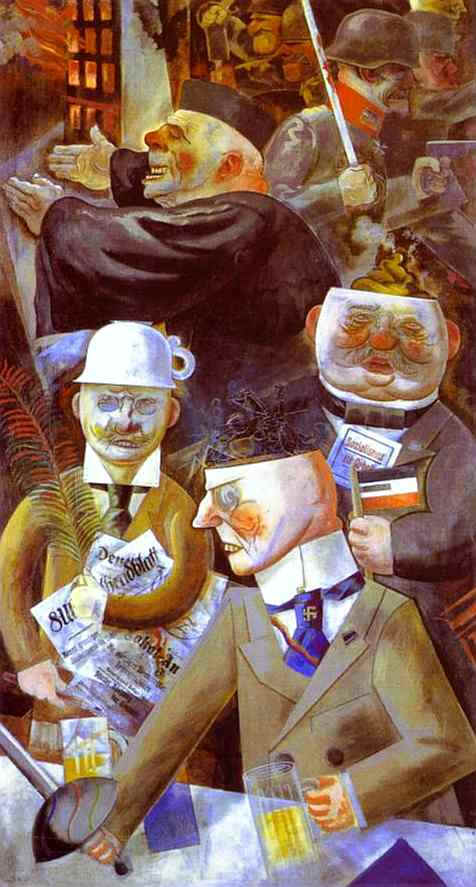
The gaze: as if we were searching for our neighbours' faces to see how human beings still looked. (The deep, inward-looking gaze of the portraits of Late Antiquity). The Verists: fascination with anonymous cripples and prostitutes, cocaine-addicted performers, marginals of all shapes and sizes, delinquents, degenerates and criminals..all elicited the unflinching gaze: to locate the grotesque in everyday urban life and in the faces of the respectable and criminal alike. The beast was within, not on the frontiers and the desire to learn to out stare nothingness, look into the eyes of Medusa, was a sort of intoxication.
~
A fierce sincerity..to mirror the world, including the perverse, nocturnal creatures hitherto excluded. To map the soul of the theatrical self, the so-called pillars of society with their absurd pretension.
.
At the same time, an acute awareness that they were at a historical juncture, a threshold. At such frontiers all sorts of people cross paths: the fabulously rich and the war veteran begging for money. And this scene is repeated today outside the favelas. Here, in a moment, the wounded cross paths with the gluttonous.
.
And still we push on , with our 'development ladders' (one billion people live in slums, three people have as much money as the poorest 48 nations). Platzangst: the illusion that one has made no progress while one has been attempting to cross a vast, unending square. The problem for the moderns is that they worry, to paraphrase Gertrude Stein, that there is no there there.
.
The old and the unworldly had the worst of it. Many were driven to begging, many to suicide. The young and the quick-witted did well. Overnight, they became free, rich and independent. It was a situation in which mental inertia and reliance on past experience were punished by starvation and death, but rapid appraisal of new situations and speed of reaction were rewarded with sudden vast riches. The twenty-one-year-old bank director appeared on the scene and also the high-school senior who earned his living from the stock-market tips of his slightly older friends...
.
Amid all the misery, despair, and poverty there was an atmosphere of light-headed youthfulness, licentiousness and carnival. Now, for once the young had money and the old did not. Moreover, its nature had changed. Its value lasted only a few hours. It was spent as never before and never since; and not on the things only old people spend their money on. Bars and nightclubs opened in large numbers. Young couples whirled about the streets of the amusement quarters. Everyone was hectically, feverishly, searching for love and seizing it without a second thought. Indeed, even love had assumed an inflationary character.
---from Sebastian Hafner, Defying Hitler.
.
The gaze: as if we were searching for our neighbours' faces to see how human beings still looked. (The deep, inward-looking gaze of the portraits of Late Antiquity). The Verists: fascination with anonymous cripples and prostitutes, cocaine-addicted performers, marginals of all shapes and sizes, delinquents, degenerates and criminals..all elicited the unflinching gaze: to locate the grotesque in everyday urban life and in the faces of the respectable and criminal alike. The beast was within, not on the frontiers and the desire to learn to out stare nothingness, look into the eyes of Medusa, was a sort of intoxication.
~
A fierce sincerity..to mirror the world, including the perverse, nocturnal creatures hitherto excluded. To map the soul of the theatrical self, the so-called pillars of society with their absurd pretension.
.
At the same time, an acute awareness that they were at a historical juncture, a threshold. At such frontiers all sorts of people cross paths: the fabulously rich and the war veteran begging for money. And this scene is repeated today outside the favelas. Here, in a moment, the wounded cross paths with the gluttonous.
.
And still we push on , with our 'development ladders' (one billion people live in slums, three people have as much money as the poorest 48 nations). Platzangst: the illusion that one has made no progress while one has been attempting to cross a vast, unending square. The problem for the moderns is that they worry, to paraphrase Gertrude Stein, that there is no there there.


No comments:
Post a Comment